
Isosceles Triangle Construction and Analysis
Loading the math board and drawing, please wait…
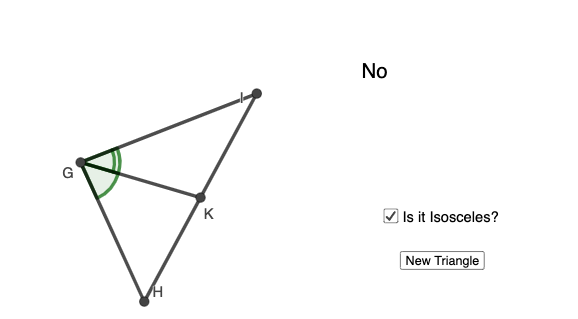
This example demonstrates how to draw and analyze isosceles triangles, highlighting geometric construction principles. Key mathematical concepts include triangle properties, the relationship between circles and triangles, and coordinate geometry. Construction involves GeoGebra commands like Circle, RandomPointIn, Midpoint, Angle, and If to create dynamic isosceles triangles. Suitable for middle school or high school students learning geometric construction and analytic geometry, useful for math teaching support and geometric thinking training.
GeoGebra Commands & Parameters
Circle(A, B) → cCircle(C, D) → dCircle(E, F) → eRandomPointIn(c) → GRandomPointIn(d) → HRandomPointIn(e) → IMidpoint(H, I) → KSegment(G, H) → fSegment(H, I) → gSegment(I, G) → hAngle(I, H, G) → aaAngle(G, I, H) → bbAngle(H, G, I) → ccSegment(G, H) → iSegment(H, I) → jSegment(I, G) → kSegment(G, H) → lSegment(H, I) → mSegment(I, G) → pSegment(G, H) → qSegment(H, I) → rSegment(I, G) → sAngle(H, G, I) → αAngle(G, I, H) → βAngle(I, H, G) → γSegment(G, K) → tAngle(I, K, G) → δAngle(G, K, H) → εAngle(G, K, H) → ζAngle(H, G, K) → ηAngle(K, G, I) → θAngle(H, G, K) → ιAngle(K, G, I) → κSegment(H, K) → aSegment(K, I) → bAngle(I, K, G) → λAngle(G, K, H) → μAngle(I, K, G) → νAngle(G, K, H) → ξAngle(H, G, K) → οAngle(K, G, I) → ρAngle(I, K, G) → σAngle(G, K, H) → τIf(n ∈ {2, 3, 5, 6, 11, 14}, "Yes!", "No") → text1
AI Drawing Prompt Reference
Draw an isosceles triangle constructed by the intersection points of three circles, highlighting the geometric relationship between circles and triangles. Start by drawing three circles and randomly selecting a point from each circle to form the triangle. Then calculate and label the midpoints and key angles of the triangle. Finally, display specific text prompts based on the angle values.
The prompt above was compiled from the original drawing commands and is for reference only.