
Isosceles Triangle and Polygon
Loading the math board and drawing, please wait…
In collections
geometriadinamica.es
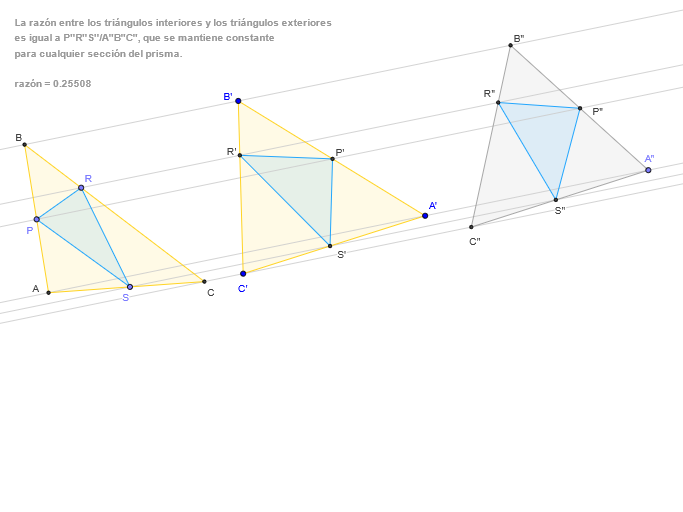
This example demonstrates the properties of isosceles triangles and their relationship with polygons. Key mathematical concepts include the properties of isosceles triangles and polygon construction. Using GeoGebra commands such as Polygon, Point, Line, etc., it dynamically illustrates the angle bisectors, medians, and other geometric elements of isosceles triangles. Suitable for students at the junior high school level and above for geometric construction.
GeoGebra Commands & Parameters
Polygon(A, B, C) → poly1, c, a, bPoint(b) → SPoint(a) → RPoint(c) → PLine(A, D) → jPoint(j) → A'Line(A, A') → dPoint(d) → A''OrthogonalLine(A'', d) → pLine(B, d) → fLine(S, f) → iLine(P, f) → hLine(R, f) → gIntersect(f, p) → HLine(C, d) → eAngularBisector(e, f) → q,Intersect(e, p) → ICircle(I, H) → rIntersect(r, q) → L, MRay(A'', M) → sOrthogonalLine(M, s) → tIntersect(e, t) → C''Intersect(t, f) → B''Polygon(A'', C'', B'') → poly5, n, d_2, oIntersect(o, h) → P''Intersect(d_2, g) → R''Intersect(n, i) → S''Polygon(P'', R'', S'') → poly6, s'', p'', r''Point(f) → B'Point(e) → C'Polygon(A', B', C') → poly2, c', a', b'Intersect(p, q) → JIntersect(b', i) → S'Polygon(P, R, S) → poly3, s_1, p_1, r_1Intersect(c', h) → P'Intersect(a', g) → R'Polygon(P', R', S') → poly4, s', p', r'
AI Drawing Prompt Reference
Draw an isosceles triangle and construct several related polygons based on it. Start with the triangle, place points on each side, and draw a perpendicular from the vertex to the opposite side to form an altitude. Then, use intersections of the altitude with angle bisectors to construct an incircle. Next, through the circle's intersections with the altitude, draw perpendiculars to form a second triangle, and connect points on its sides to create inner triangles. Finally, take points on the triangle's sides and connect them to form another triangle, using intersections of angle bisectors and altitudes to construct nested triangles that demonstrate the symmetry of the isosceles triangle.
The prompt above was compiled from the original drawing commands and is for reference only.