
Isosceles Trapezoid Construction by John Strand
Loading the math board and drawing, please wait…
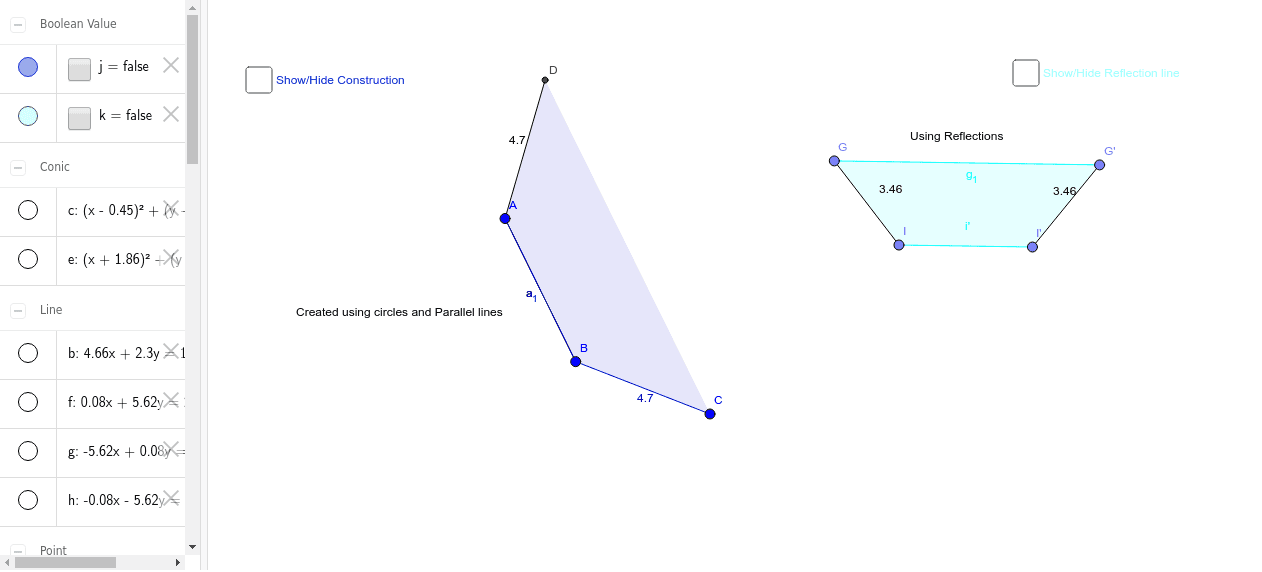
This example demonstrates the geometric construction of an isosceles trapezoid using circles and reflections. Key math concepts include isosceles triangles, trapezoids, circles, and reflections. The construction involves GeoGebra commands such as Segment, Circle, Line, Intersect, Polygon, Point, Mirror, and OrthogonalLine. Suitable for middle school students and above to learn geometric construction and spatial reasoning.
GeoGebra Commands & Parameters
Segment(A, B) → aCircle(B, C) → cLine(C, a) → bSegment(B, C) → dCircle(A, d) → eIntersect(e, b, 1) → DPolygon(B, C, D, A) → poly1, b_1, c_1, d_1, a_1Line(E, F) → fPoint(f) → GMirror(G, F) → G'OrthogonalLine(F, f) → gPoint(g) → HOrthogonalLine(H, g) → hPoint(h) → IMirror(I, H) → I'Polygon(G, G', I', I) → poly2, g_1, g', i', i
AI Drawing Prompt Reference
Draw an isosceles trapezoid by first drawing a base line, then using one endpoint of the base as the center to draw a circle intersecting a perpendicular line to the base, obtaining a point. Connect this point to the other endpoint of the base. Next, use the other endpoint as the center to draw another circle intersecting the perpendicular line, obtaining another point. Connect these two points to the base endpoints to form the isosceles trapezoid. Then, using the midpoint of the top base as the center, draw a circle intersecting the perpendicular line to get two points. Connect these points and extend them upward and downward, intersecting the perpendicular line at two more points, and connect these points to form another isosceles trapezoid.
The prompt above was compiled from the original drawing commands and is for reference only.