
Investigation of Parallelogram Diagonals Relationship (Part 5)
Loading the math board and drawing, please wait…
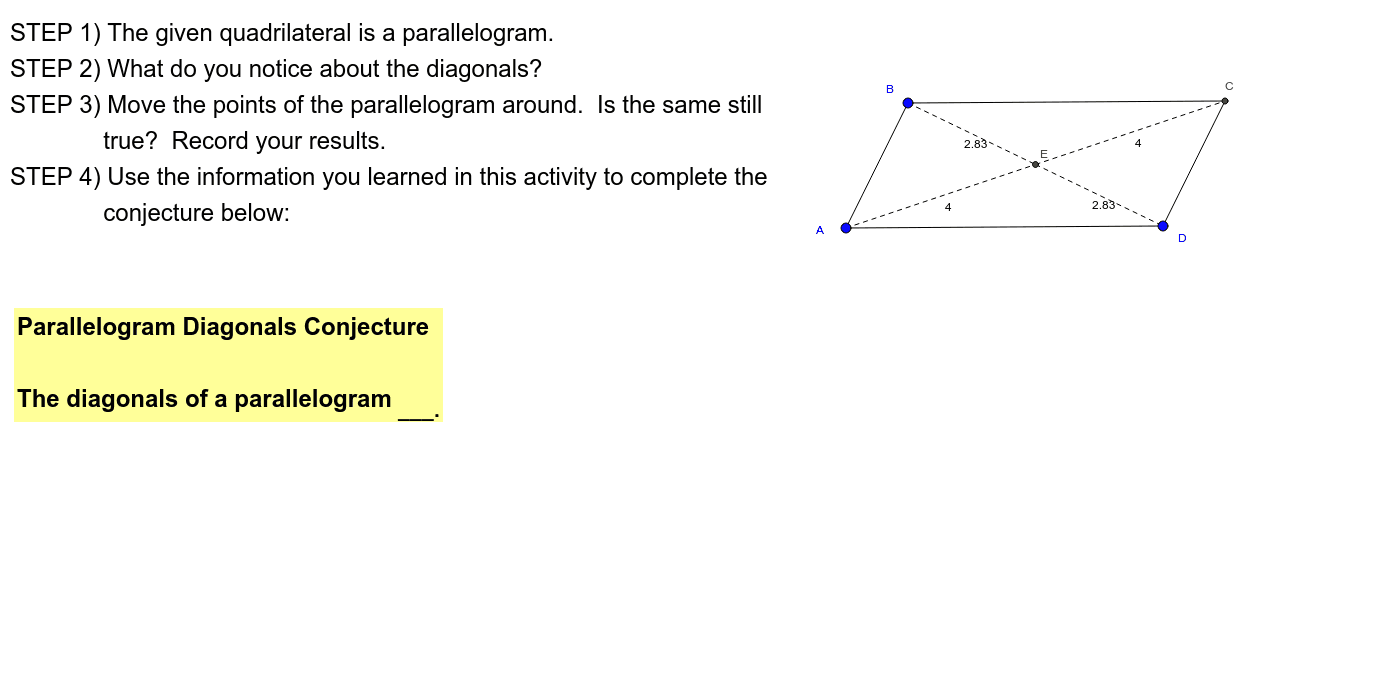
① This example demonstrates the geometric relationship among the diagonals of a parallelogram, including their intersection properties and length relationships. ② Core concepts involve parallelograms, diagonals, vectors, triangles, congruent triangles, and coordinate geometry. ③ Construction highlights use the Segment, Line, and Intersect commands to draw vertices, sides, and diagonals, allowing interactive exploration of intersection points and lengths. ④ Designed for high‑school geometry classes and math Olympiad preparation.
GeoGebra Commands & Parameters
Segment(A, D) → aSegment(A, B) → bLine(B, a) → cLine(D, b) → dIntersect(c, d) → CSegment(B, C) → eSegment(D, C) → fSegment(B, D) → gSegment(A, C) → hIntersect(g, h) → ESegment(B, E) → iSegment(E, D) → jSegment(E, C) → kSegment(A, E) → l
AI Drawing Prompt Reference
Draw a parallelogram ABCD by first providing adjacent sides AB and AD, then constructing through B a line parallel to AD and through D a line parallel to AB; their intersection defines vertex C. Next draw the two diagonals AC and BD and mark their intersection as point E. Finally connect E to each vertex A, B, C, D, producing segments AE, BE, CE, and DE, while keeping the four sides and both diagonals visible.
The prompt above was compiled from the original drawing commands and is for reference only.