
Investigate Properties of Kites
Loading the math board and drawing, please wait…
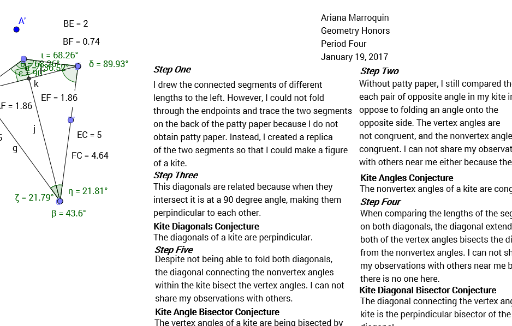
This example demonstrates the properties of kites, involving similar triangles. Using GeoGebra commands such as points, segments, distances, and angles, it illustrates the geometric characteristics of kites. Suitable for middle school and above students to learn geometric construction.
GeoGebra Commands & Parameters
Point(Circle[A, 2]) → BSegment(A, B) → fPoint(Circle[A, 5]) → CSegment(A, C) → gPoint(Circle[B, 2]) → DSegment(B, D) → hDistance(C, A) → distanceCAPoint(Circle[C, 5]) → ESegment(C, E) → iDistance(B, E) → distanceBEDistance(A, B) → distanceABDistance(A, C) → distanceACDistance(E, C) → distanceECAngle(A, B, E) → αAngle(E, C, A) → βAngle(C, A, B) → γRotate(B, 89.93°, E) → B'Angle(B, E, B') → δSegment(B, C) → jSegment(A, E) → kIntersect(j, k) → FRotate(A, (-(90°)), F) → A'Angle(A', F, A) → εDistance(A, F) → distanceAFDistance(E, F) → distanceEFDistance(B, F) → distanceBFDistance(F, C) → distanceFCAngle(E, C, F) → ζAngle(F, C, A) → ηAngle(A, B, F) → θAngle(F, B, E) → ι
AI Drawing Prompt Reference
Draw a kite ABCE with A, B, and C forming an isosceles triangle where AB=AC and BC is the base. Then draw point D such that BD is parallel to AC and of equal length, and draw point E such that CE is parallel to AB and of equal length. Connect points A and E, B and D, C and E, E and F, F and C, F and A, and F and B. Finally, measure the lengths of the sides and angles to observe the properties of the kite.
The prompt above was compiled from the original drawing commands and is for reference only.