
Inv 3.2: Coordinate Rules for Translations – Polygon Transformation Demo
Loading the math board and drawing, please wait…
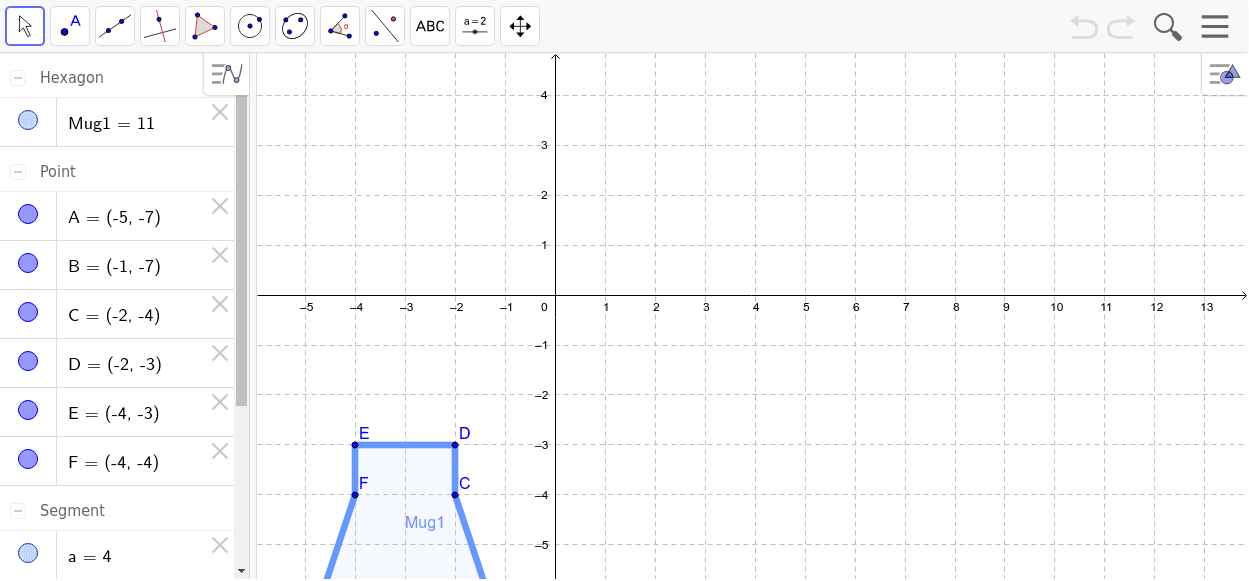
This GeoGebra example demonstrates coordinate rules for translations in the plane, illustrating how a polygon changes position while preserving shape, size, and orientation under a rigid transformation. Core mathematical concepts include translation, transformation geometry, coordinate geometry, and polygonal construction. The construction relies on the GeoGebra Polygon command, using points A through F and segments a through f to define the original figure and its translated image, with Mug1 serving as a reference or control object. It is suitable for middle school and high school mathematics instruction, classroom demonstrations, inquiry-based learning, and independent student practice of translation coordinate rules.
GeoGebra Commands & Parameters
Polygon(A, B, C, D, E, F) → Mug1, a, b, c, d, e, f
AI Drawing Prompt Reference
Draw a polygon with six vertices, forming an irregular shape with clear edges. Then draw a translated copy of this polygon, keeping its shape, size, and orientation exactly the same, only shifting its position. Use different colors or line styles to distinguish the original and the translated polygon, and indicate the corresponding vertices between them. The overall composition should demonstrate the effect of a translation transformation, highlighting how the figure's position changes under coordinate rules.
The prompt above was compiled from the original drawing commands and is for reference only.