
Intuitive Discovery of the Derivative of Cosine Function
Loading the math board and drawing, please wait…
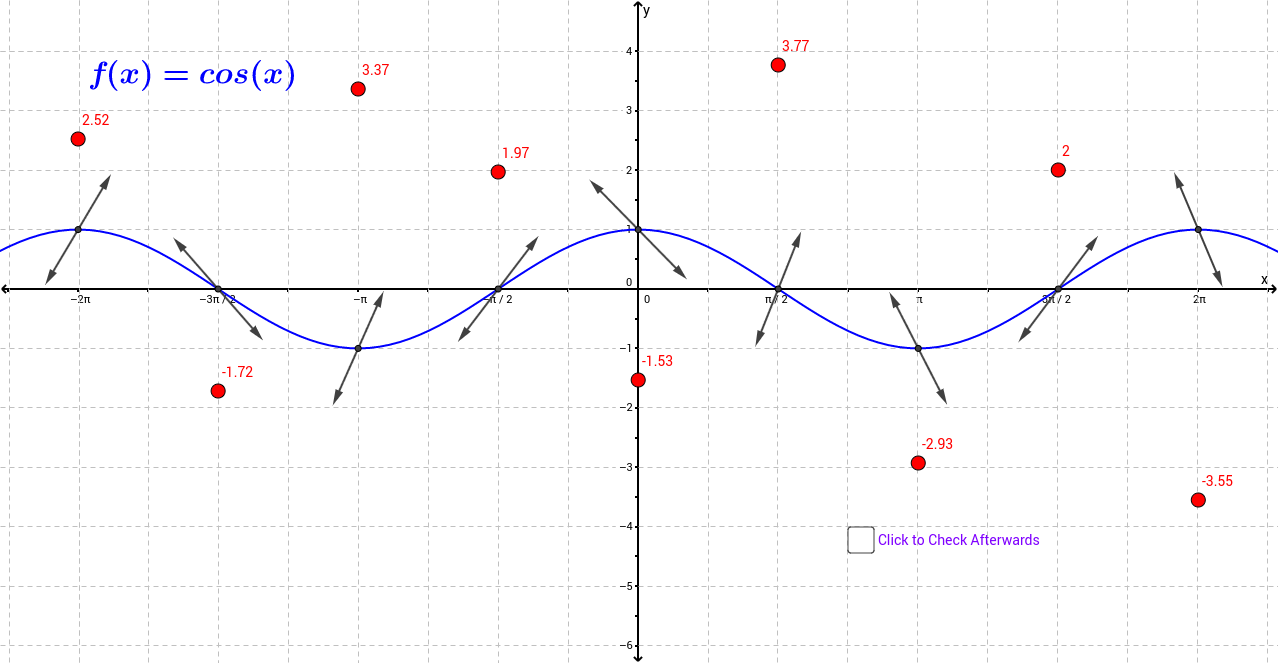
This applet helps students intuitively discover that the derivative of the cosine function is the negative of the sine function. It involves key mathematical concepts such as trigonometric functions and derivatives. Using GeoGebra commands like Random, RandomElement, Point, etc., dynamic geometric figures are constructed to demonstrate the changes in function graphs. Suitable for high school mathematics education.
GeoGebra Commands & Parameters
Random(1, 2) → bRandom(-3, 3) → cRandom(-3, 3) → dRandomElement(list1) → aPoint(vert_A) → ACircle((x(A), g(x(A))), 1) → circle_AIntersect(circle_A, line_A, 1) → A_2Intersect(circle_A, line_A, 2) → A_3Intersect(g, vert_A, (0, 1)) → A_1Vector(A_1, A_3) → u_AVector(A_1, A_2) → v_APoint(vert_B) → BCircle((x(B), g(x(B))), 1) → circle_BIntersect(g, vert_B, (1.5707963267948966, 6.123233995736766E-17)) → B_1Intersect(circle_B, line_B, 1) → B_2Intersect(circle_B, line_B, 2) → B_3Vector(B_1, B_2) → u_BVector(B_1, B_3) → v_BPoint(vert_C) → CIntersect(g, vert_C, (3.141592653589793, -1)) → C_1Circle((x(C), g(x(C))), 1) → circle_CIntersect(circle_C, line_C, 1) → C_2Intersect(circle_C, line_C, 2) → C_3Vector(C_1, C_3) → u_CVector(C_1, C_2) → v_CPoint(vert_D) → DCircle((x(D), g(x(D))), 1) → circle_DIntersect(g, vert_D, (4.71238898038469, -1.8369701987210297E-16)) → D_1Intersect(circle_D, line_D, 1) → D_2Intersect(circle_D, line_D, 2) → D_3Vector(D_1, D_2) → u_DVector(D_1, D_3) → v_DPoint(vert_E) → ECircle((x(E), g(x(E))), 1) → circle_EIntersect(g, vert_E, (6.283185307179586, 1)) → E_1Intersect(circle_E, line_E, 1) → E_2Intersect(circle_E, line_E, 2) → E_3Vector(E_1, E_2) → u_EVector(E_1, E_3) → v_EPoint(vert_F) → FCircle((x(F), g(x(F))), 1) → circle_FIntersect(g, vert_F, (-1.5707963267948966, 6.123233995736766E-17)) → F_1Intersect(circle_F, line_F, 1) → F_3Intersect(circle_F, line_F, 2) → F_2Vector(F_1, F_3) → u_FVector(F_1, F_2) → v_FPoint(vert_G) → GCircle((x(G), g(x(G))), 1) → circle_GIntersect(g, line_G, (-3.141592653589793, -1)) → G_1Intersect(circle_G, line_G, 1) → G_2Intersect(circle_G, line_G, 2) → G_3Vector(G_1, G_2) → u_GVector(G_1, G_3) → v_GPoint(vert_H) → HCircle((x(H), g(x(H))), 1) → circle_HIntersect(g, line_H, (-4.71238898038469, -1.8369701987210297E-16)) → H_1Intersect(circle_H, line_H, 1) → H_2Intersect(circle_H, line_H, 2) → H_3Vector(H_1, H_2) → u_HVector(H_1, H_3) → v_HPoint(vert_I) → ICircle((x(I), g(x(I))), 1) → circle_IIntersect(circle_I, line_I, 1) → I_2Intersect(circle_I, line_I, 2) → I_3Intersect(g, line_I, (-6.283185307179587, 1)) → I_1Vector(I_1, I_2) → u_IVector(I_1, I_3) → v_I