
Introduction to Transformational Geometry by Dan Dale
Loading the math board and drawing, please wait…
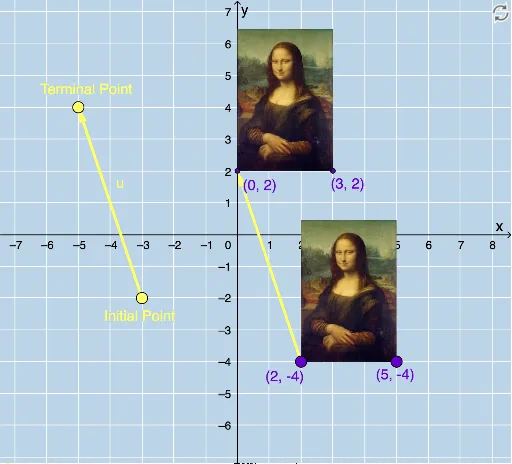
This example demonstrates geometric transformations including dilation, reflection, rotation, and translation. The core math concepts involved are transformations, vectors, percentages, median, mode, and expected value. It is constructed using GeoGebra commands and objects like Vector, Translate, Rotate, CircleArc, Circle, Line, Mirror, Dilate, and Textfield. Suitable for middle school and above students to learn and understand the basic principles and applications of geometric transformations.
GeoGebra Commands & Parameters
Vector(D, E) → uTranslate(pic1, u) → pic1'Translate(B, u) → B'Translate(C, u) → C'Vector(B, B') → vRotate(C, δ, A) → C'_1CircleArc(A, C'_1, C) → cCircleArc(A, C, C'_1) → dCircle(A, C) → eLine(F, G) → fMirror(pic1, f) → pic1'_2Mirror(B, f) → B'_2Mirror(C, f) → C'_2Dilate(pic1, k, A) → pic1'_3Dilate(B, k, A) → B'_3Dilate(C, k, A) → C'_3Rotate(B, δ, A) → B'_1Rotate(pic1, δ, A) → pic1'_1Circle(A, C) → pCircleArc(A, C'_1, C) → rTextfield(δ) → InputBox1Textfield(k) → InputBox2
AI Drawing Prompt Reference
Draw a geometric transformation example showing how to transform shapes using vector translation, rotation, reflection, and dilation. Start by drawing a shape and translating it using a vector, then rotate it around a specified point by a given angle, reflect it over a line, and finally scale it according to a given factor and center point. The entire process clearly demonstrates the effects of various geometric transformations.
The prompt above was compiled from the original drawing commands and is for reference only.