
Introducing the number i: visual and algebraic meaning of the imaginary unit
Loading the math board and drawing, please wait…
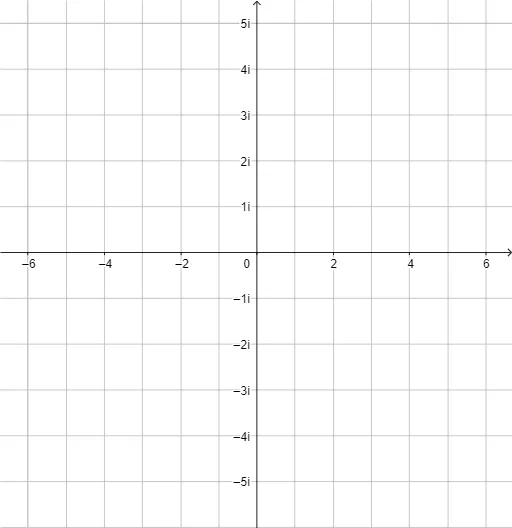
This example demonstrates how the imaginary unit i (with the defining property i^2 = -1) can be introduced by connecting algebraic rules to visual/geometric representations. It helps learners understand what it means to “take the square root of a negative number” through the extension from real numbers to complex numbers. Key concepts include complex numbers, the definition of the imaginary unit i, and the algebraic identity i^2 = -1, together with its geometric interpretation in a coordinate-plane setting (often related to the complex plane). For construction, the original command summary is not provided; a typical GeoGebra workflow is to (1) define i via the rule i^2 = -1, (2) verify resulting equivalences, and (3) display the corresponding objects on a 2D coordinate system so the algebraic relationship is reflected in the geometry. Suitable for later high school (intro to complex numbers) and early undergraduate math/engineering courses, as a classroom demo or self-study resource.
AI Drawing Prompt Reference
Draw a 2D coordinate plane representing the complex plane, with the horizontal axis as the real axis and the vertical axis as the imaginary axis. Mark the origin. Place a point at (0,1) on the positive imaginary axis to represent the imaginary unit i, and draw an arrow from the origin to this point. Also mark a point at (-1,0) on the negative real axis. Connect the origin, the point (0,1), and the point (-1,0) with dashed lines to form a right triangle, illustrating the geometric meaning of i^2 = -1. Add a text label near the triangle stating that i^2 = -1, and optionally indicate a 90-degree rotation relationship between the real and imaginary axes.
The prompt above was compiled from the original drawing commands and is for reference only.