
Intersection of Two Orthogonal Cylinders
Loading the math board and drawing, please wait…
In collections
intersection: surface-surface, curve-curve
intersection: surface-surface, curve-curve
intersection: surface-surface, curve-curve
intersection: surface-surface, curve-curve
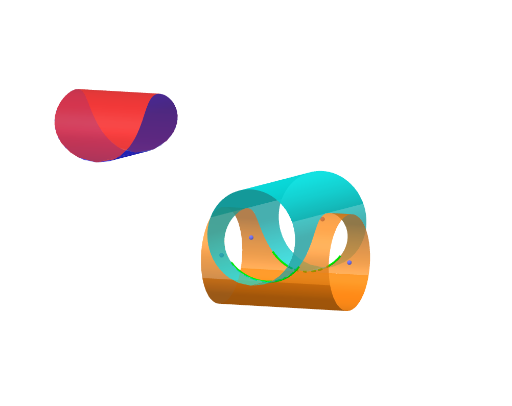
This example demonstrates the intersection of two orthogonal cylinders. Key math concepts include solid geometry, intersection, and cylinders. It is constructed using GeoGebra commands like Ray, Point, CurveCartesian, Cylinder, Surface, If. Suitable for high school solid geometry learning or introductory mathematical modeling.
GeoGebra Commands & Parameters
Ray((0, b, c), (0, b + 1, c)) → dda'Point(dda') → A'Ray((0, (-b), c), (0, (-b) - 1, c)) → ddaPoint(dda) → ARay(((-a), 0, (-c)), ((-a) - 1, 0, (-c))) → ddbPoint(ddb) → BRay((a, 0, (-c)), (a + 1, 0, (-c))) → ddb'Point(ddb') → B'CurveCartesian((a * cos(t)), sqrt(b^(2) - ((2 * c) + (a * sin(t)))^(2)), c + (a * sin(t)), t, 0, 6.283185307179586) → dCurveCartesian((a * cos(t)), (-sqrt(b^(2) - ((2 * c) + (a * sin(t)))^(2))), c + (a * sin(t)), t, 0, 6.28319) → eCylinder(B', B, b) → cylb, f, g, jCylinder(A, A', a) → cyla, k, h, iSurface((a * cos(u)), (y(A') * (1 - v)) + (v * sqrt(b^(2) - ((2 * c) + (a * sin(u)))^(2))), c + (a * sin(u)), u, 0, 6.28319, v, 0, 1) → cpa1Surface((a * cos(u)), (y(A) * (1 - v)) - (v * sqrt(b^(2) - ((2 * c) + (a * sin(u)))^(2))), c + (a * sin(u)), u, 0, 6.28319, v, 0, 1) → cpa2Surface(x(A) + (a * cos(u)), (y(A') * v) + ((1 - v) * y(A)), z(A) + (a * sin(u)), u, π - asin(((-b) - (2 * c)) / a), (2 * π) + asin(((-b) - (2 * c)) / a), v, 0, 1) → cpa4Surface((x(B') * (1 - v)) + ((v * a) * cos(u)), sqrt(b^(2) - ((2 * c) + (a * sin(u)))^(2)), c + (a * sin(u)), u, -1.5707963267948966, 1.5708, v, 0, 1) → cpb1Surface((x(B) * (1 - v)) + ((v * a) * cos(u)), sqrt(b^(2) - ((2 * c) + (a * sin(u)))^(2)), c + (a * sin(u)), u, 1.5708, 4.71238898038469, v, 0, 1) → cpb2Surface((x(B') * (1 - v)) + ((v * a) * cos(u)), (-sqrt(b^(2) - ((2 * c) + (a * sin(u)))^(2))), c + (a * sin(u)), u, -1.5707963267948966, 1.5707963267948966, v, 0, 1) → cpb3Surface((x(B) * (1 - v)) + ((v * a) * cos(u)), (-sqrt(b^(2) - ((2 * c) + (a * sin(u)))^(2))), c + (a * sin(u)), u, 1.5707963267948966, 4.71238898038469, v, 0, 1) → cpb4Surface((x(B') * (1 - v)) + (v * x(B)), (b * cos(u)), z(B') + (b * sin(u)), u, asin((a + (2 * c)) / b), π - asin((a + (2 * c)) / b), v, 0, 1) → cpb5If(-1 ≤ (b - (2 * c)) / a ≤ 1, asin((b - (2 * c)) / a), If[-1 ≤ (b + (2 * c)) / a ≤ 1, π + asin((b + (2 * c)) / a), 0]) → uadIf(-1 ≤ (b - (2 * c)) / a ≤ 1, π - asin((b - (2 * c)) / a), If[-1 ≤ (b + (2 * c)) / a ≤ 1, (2 * π) - asin((b + (2 * c)) / a), 0]) → uafSurface(x(A) + (a * cos(u)), (y(A') * v) + ((1 - v) * y(A)), z(A) + (a * sin(u)), u, uad, uaf, v, 0, 1) → cpa3If(-1 ≤ (a - (2 * c)) / b ≤ 1, π + asin((a - (2 * c)) / b), If[-1 ≤ (a + (2 * c)) / b ≤ 1, asin((a + (2 * c)) / b), 0]) → ubdIf(-1 ≤ (a - (2 * c)) / b ≤ 1, (2 * π) - asin((a - (2 * c)) / b), If[-1 ≤ (a + (2 * c)) / b ≤ 1, π - asin((a + (2 * c)) / b), 0]) → ubfSurface((x(B') * (1 - v)) + (v * x(B)), (b * cos(u)), z(B') + (b * sin(u)), u, ubd, ubf, v, 0, 1) → cpbSurface((10 * p) + ((v * a) * cos(u)), (-10 * p) - sqrt(b^(2) - ((2 * c) + (a * sin(u)))^(2)), (10 * p) + c + (a * sin(u)), u, 0, 6.28319, v, -1, 1) → sb'Surface((10 * p) + (a * cos(u)), (20 * q) - (10 * p) + (v * sqrt(b^(2) - ((2 * c) + (a * sin(u)))^(2))), (10 * p) + c + (a * sin(u)), u, 0, 6.28319, v, -1, 1) → saSurface((10 * p) + ((v * a) * cos(u)), (-10 * p) + sqrt(b^(2) - ((2 * c) + (a * sin(u)))^(2)), (10 * p) + c + (a * sin(u)), u, 0, 6.283185307179586, v, -1, 1) → sb
AI Drawing Prompt Reference
Draw two orthogonal cylinders and show their intersection. Start by drawing two perpendicular rays, one from (0, b, c) and the other from (0, -b, c), each of length 1. Mark points A' and A on these rays. Then draw two more perpendicular rays from (-a, 0, -c) and (a, 0, -c), each of length 1, and mark points B and B' on them. Next, create two cylinders, one with bases A and B and radius a, and the other with bases A' and B' and radius b. Finally, use surfaces to visualize the intersection of the two cylinders.
The prompt above was compiled from the original drawing commands and is for reference only.