
Intermediate Value Theorem for Continuity
Loading the math board and drawing, please wait…
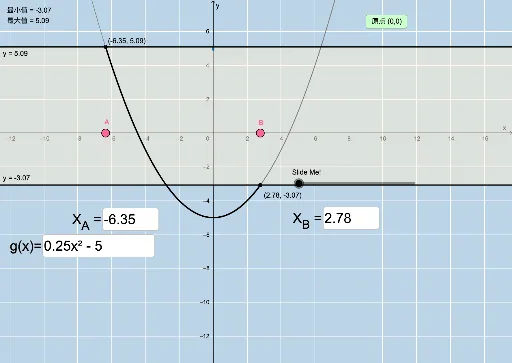
This example illustrates the Intermediate Value Theorem for continuous functions. The theorem states that if a function is continuous on a closed interval and the function values at the endpoints are different, then there must be a point within the interval where the function value equals any number between the two endpoints. The construction summary involves multiple GeoGebra commands such as Textfield, Min, Max, Dilate, Segment, Intersect, Root, etc., for drawing function graphs, defining intervals, and finding roots. Suitable for high school mathematics education and learning.
GeoGebra Commands & Parameters
Textfield(f) → InputBox1Textfield(a) → InputBox2Textfield(b) → InputBox3Min({f(a), f(b)}) → minMax({f(a), f(b)}) → maxDilate(I, If[0 < d ≤ 1, 1 - d, 0], H) → I'Segment(I, I') → f_1Intersect(j, xAxis) → KRoot(p_1, x(A), x(B)) → CIntersect(f, t) → JDilate(E, If[1 < d ≤ 2, 2 - d, 0], J) → E'_1Segment(E, E'_1) → g_1Dilate(J, If[2 < d ≤ 3, 3 - d, 0], C) → J'Segment(J, J') → rTextfield(c) → InputBox4