
Interior Angles of Polygons by Shelly Baumann
Loading the math board and drawing, please wait…
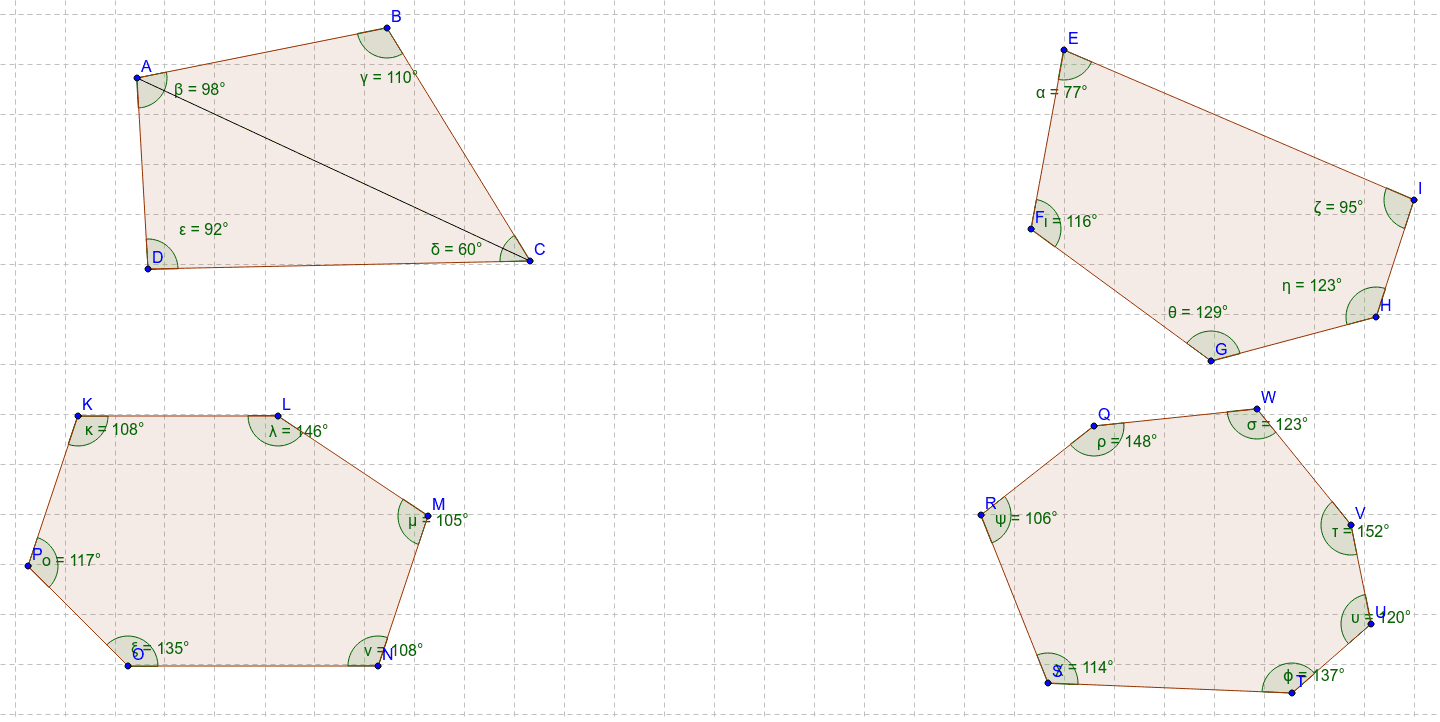
This example demonstrates the calculation and geometric construction of interior angles in polygons. Key mathematical concepts include the sum of interior angles theorem, angle measurement, and polygon construction. The construction involves using GeoGebra commands such as Polygon, Angle, and Segment to create polygon objects and compute interior angles. Suitable for middle school students learning geometry fundamentals or high school students practicing geometric constructions.
GeoGebra Commands & Parameters
Polygon(A, B, C, D) → poly1, a, b, c, dAngle(D, A, B) → βAngle(A, B, C) → γAngle(B, C, D) → δAngle(C, D, A) → εPolygon(E, F, G, H, I) → poly2, e, f, g, h, iAngle(F, E, I) → αAngle(E, I, H) → ζAngle(I, H, G) → ηAngle(H, G, F) → θAngle(G, F, E) → ιPolygon(K, L, M, N, O, P) → poly3, k, l, m, n, o, pAngle(P, K, L) → κAngle(K, L, M) → λAngle(L, M, N) → μAngle(M, N, O) → νAngle(N, O, P) → ξAngle(O, P, K) → οPolygon(Q, R, S, T, U, V, W) → poly4, q, r, s, t, u, v, wAngle(R, Q, W) → ρAngle(Q, W, V) → σAngle(W, V, U) → τAngle(V, U, T) → υAngle(U, T, S) → ϕAngle(T, S, R) → χAngle(S, R, Q) → ψPolygon(J, Z, A_1, B_1, C_1, D_1, E_1, F_1) → poly5, j, z_1, a_1, b_1, c_1, d_1, e_1, f_1Angle(B_1, C_1, D_1) → ωAngle(J, Z, A_1) → α_1Angle(E_1, F_1, J) → β_1Angle(F_1, J, Z) → γ_1Angle(Z, A_1, B_1) → δ_1Angle(A_1, B_1, C_1) → ε_1Angle(C_1, D_1, E_1) → ζ_1Angle(D_1, E_1, F_1) → η_1Segment(A, C) → g_1
AI Drawing Prompt Reference
Draw multiple polygons and display their interior angles. Start by creating a quadrilateral and label the three angles formed by its adjacent vertices. Then draw a pentagon and label the five angles formed by its adjacent vertices. Next, draw a hexagon and a heptagon, labeling the angles formed by their adjacent vertices. Finally, draw a line segment between a pair of opposite vertices of the first quadrilateral to show the basis for calculating the sum of interior angles.
The prompt above was compiled from the original drawing commands and is for reference only.