
Interior and Exterior Angles of a Triangle
Loading the math board and drawing, please wait…
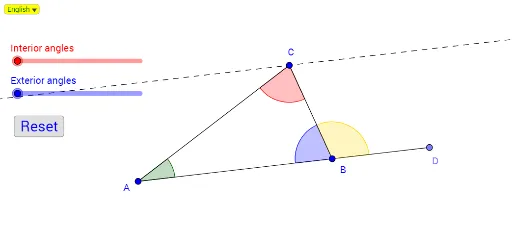
This example demonstrates the calculation and relationships between interior and exterior angles of a triangle. Core math concepts include angle measurement, the triangle angle sum theorem, and exterior angle properties. GeoGebra commands/objects used in construction include Segment, Circle, Intersect, Angle, Vector, Rotate, Translate, Line, and Point. Suitable for middle school and above students learning geometric angle relationships, or for mathematical teaching demonstrations.
GeoGebra Commands & Parameters
Segment(B, C) → bCircle(B, Saiz) → dIntersect(d, b, 1) → JAngle(A, B, C) → SdIf(Sd > 180°, 1, -1) → ArahAngle(C, B, A) → αSegment(A, B) → aIntersect(d, a, 1) → EIf(α < 180°, CircleSector[B, J, E], CircleSector[B, E, J]) → gAngle(B, A, C) → γSegment(C, A) → cCircle(A, Saiz) → fIntersect(f, a, 1) → IIntersect(f, c, 1) → HCircle(C, Saiz) → eIntersect(e, b, 1) → FIntersect(e, c, 1) → GVector(B, C) → u_1Rotate(g, ((((-m) * Arah) * 180))°, B) → g'Translate(g', Vector[(m * u_1)]) → g''If(γ < 180°, CircleSector[A, I, H], CircleSector[A, H, I]) → kRotate(k, (((m * Arah) * 180))°, A) → k'Vector(A, C) → u_2Translate(k', Vector[(m * u_2)]) → k''Angle(A, C, B) → βIf(β < 180°, CircleSector[C, G, F], CircleSector[C, F, G]) → hLine(C, a) → iLine(A, B) → jPoint(j) → DSegment(B, D) → lIntersect(d, j, 2) → KAngle(K, B, J) → δIf(δ < 180°, CircleSector[B, K, J], CircleSector[B, J, K]) → pVector(A, B) → v_1Vector(C, B) → v_2Translate(k, Vector[(n * v_1)]) → k'_1Rotate(h, (((n * Arah) * 180))°, C) → h'Translate(h', Vector[(n * v_2)]) → h''SelectedIndex(Bahasa) → nn
AI Drawing Prompt Reference
Draw a triangle and illustrate its interior and exterior angles. At each vertex, place a small arc to represent the interior angle, and use rotated or translated sectors to show the exterior angles. Position the exterior angles adjacent to the triangle to demonstrate that each exterior angle equals the sum of the two non-adjacent interior angles. Extend one side of the triangle to clearly mark an exterior angle, and use distinct colors or styles for interior angles, exterior angles, and auxiliary lines. The diagram should be clear and suitable for classroom demonstration.
The prompt above was compiled from the original drawing commands and is for reference only.