
Interior and Exterior Angles of a Regular n-gon
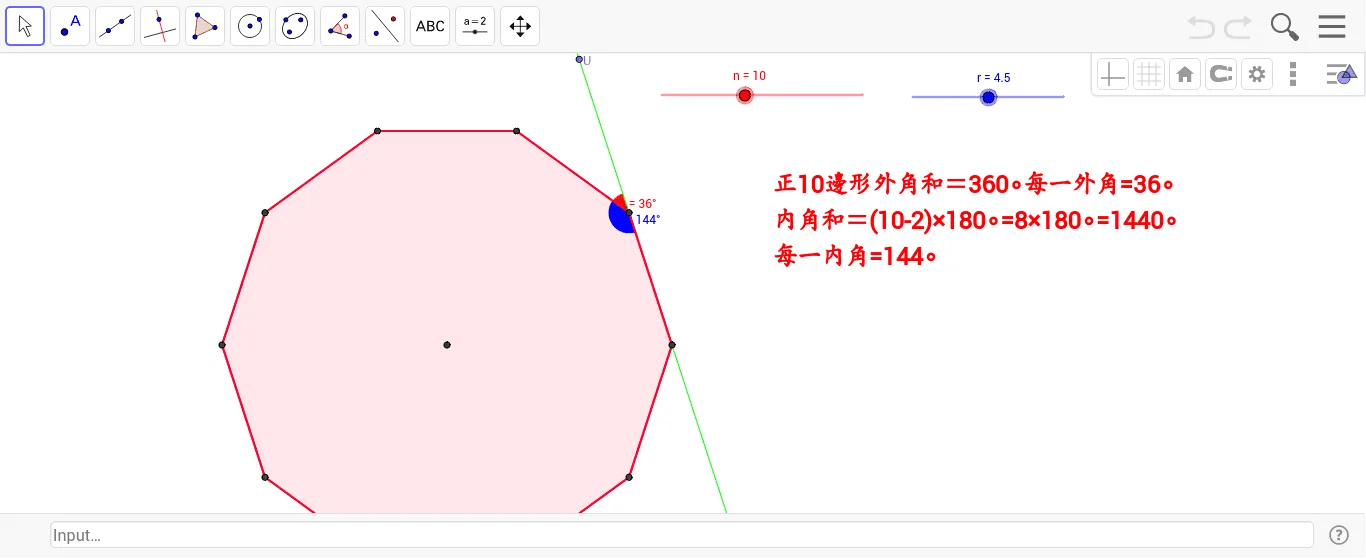
This GeoGebra applet provides a dynamic and interactive exploration of the geometric properties governing the interior and exterior angles of a regular n-gon. Designed as a comprehensive visual tool for plane geometry, it allows students and educators to investigate how the angles of a regular polygon behave as the number of sides changes. At the core of the applet is an intuitive slider that controls the variable n, representing the number of sides of the polygon. By adjusting this slider, users can seamlessly transform the shape from a basic triangle or square into complex polygons with dozens of sides, observing the geometric transformations in real time.
As the polygon morphs, the applet automatically calculates and displays the precise measurements of both the interior and exterior angles. Students can visually verify fundamental polygon angle theorems, such as the formula for the sum of the interior angles, which is always equal to (n-2) multiplied by 180 degrees. Furthermore, the applet beautifully illustrates the invariant nature of the sum of the exterior angles, which consistently totals 360 degrees regardless of the value of n. Beyond the aggregate sums, the tool highlights the relationship at any single vertex, clearly demonstrating that an interior angle and its corresponding exterior angle are supplementary, always adding up to 180 degrees. It also allows users to track the individual measure of a single interior angle and a single exterior angle, showing how they relate algebraically to the total number of sides.
Constructed using precise GeoGebra commands, including polygon generation, geometric rotations, and dynamic angle measurements, the model ensures mathematical accuracy while maintaining a clean and uncluttered visual interface. This meticulous construction allows learners to focus entirely on the mathematical relationships rather than getting bogged down in manual calculations.
The educational benefits of this applet are substantial. It bridges the gap between abstract algebraic formulas and concrete geometric realities, fostering a deeper conceptual understanding. Instead of merely memorizing equations, students can discover the patterns themselves through guided exploration. For instance, as they increase n to a very large number, they can visually and numerically observe how the interior angles approach 180 degrees and the exterior angles approach zero, providing an intuitive introduction to limits and the concept of a circle as a polygon with infinite sides. Ultimately, this interactive environment empowers students to build geometric intuition, verify mathematical conjectures, and master the foundational theorems of polygon geometry with confidence.
In collections
Polygons
Loading the math board and drawing, please wait…