
Interactive Practice of the Power of a Quotient Using Exponent Rules
Loading the math board and drawing, please wait…
In collections
Rechnen mit Potenzen
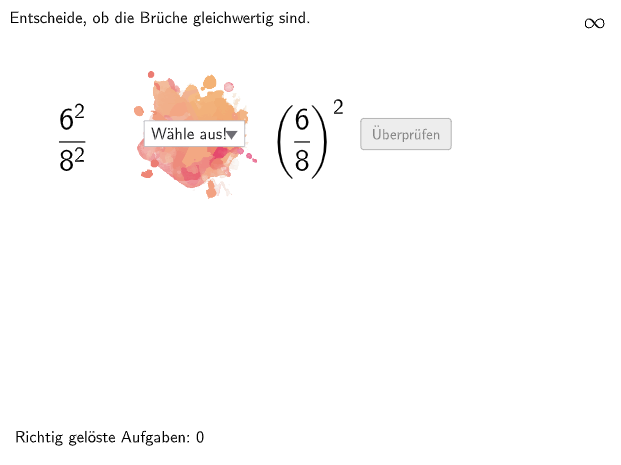
This example demonstrates and checks the rule for the power of a quotient by turning the (a/b)^n computation into an interactive GeoGebra lesson. The main math concepts are elementary exponent rules—especially how division interacts with powers—along with algebraic simplification and verification of whether a student’s result matches the correct form. The construction and interaction are driven by: Textfield input boxes (input1, input2, etc.), Shuffle to generate randomized problem instances, SelectedIndex and If to branch logic based on user choices/conditions, and Join to assemble expressions/expected forms. It also uses Element with Append/Remove (and Polygon in the display layer) to manage what is shown or updated. For learning support, it includes validate/showanswer/showsolution with controls like btnValidate, btnTryAgain, btnNew, hint display, and counters attemptCount/correctCount to provide feedback. Suitable for grades 7–8 and for classroom practice, homework, or self-assessment focused on exponent operations.
GeoGebra Commands & Parameters
Textfield(input1) → InputBox1Textfield(input2) → InputBox2Shuffle({1, 2, 3, 4}) → ModusList, {3, 4, 1, 2}Shuffle(1…2) → ModusListGleich, {2, 1}Shuffle({ModusList, ModusListGleich, ModusList}) → ModusListJuggler, {{3, 4, 1, 2}, {2, 1}, {3, 4, 1, 2}}Shuffle({ModusListGleich, ModusList, ModusList}) → ModusListFirstThree, {{2, 1}, {3, 4, 1, 2}, {3, 4, 1, 2}}Join({ModusListFirstThree, {ModusListJuggler(1)}}) → ModusListGlobalIf(questionCount < 4, questionCount, 4) → localindexShuffle(Sequence[i, i, 2, 8]) → AList, {6, 4, 7, 5, 3, 8, 2}Shuffle(Sequence[i, i, avalue + 1, 9]) → BList, {8, 7, 9}SelectedIndex(DD1) → index1Shuffle(Sequence[i, i, 2, 3]) → XList, {2, 3}If(modus1 ≟ 1, (avalue / bvalue)^(xvalue), modus1 ≟ 2, (avalue / bvalue)^(xvalue), modus1 ≟ 3, avalue^(xvalue) / bvalue, avalue / bvalue^(xvalue)) → value1If(modus2 ≟ 1, (avalue / bvalue)^(xvalue), modus2 ≟ 2, (avalue / bvalue)^(xvalue), modus2 ≟ 3, avalue^(xvalue) / bvalue, avalue / bvalue^(xvalue)) → value2Polygon(PtopLeftCornerFeedback, PtopRightCornerFeedback, PbottomRightCornerFeedback, PbottomLeftCornerFeedback) → rectangleCorrect, rectangleCorrectS3, rectangleCorrectS4, rectangleCorrectS2, rectangleCorrectS1Shuffle(Sequence[Random[0, 10], i, 1, 100]) → randomNosForX, {10, 0, 0, 6, 1, 9, 4, 2, 1, 3, 3, 5, 1, 4, 0, 0, 5, 7, 4, 5, 9, 8, 4, 2, 6, 1, 4, 9, 3, 6, 2, 1, 10, 7, 5, 2, 0, 1, 8, 10, 0, 4, 4, 2, 3, 6, 2, 0, 1, 7, 8, 3, 7, 9, 10, 6, 9, 8, 6, 7, 4, 1, 3, 5, 0, 0, 10, 7, 6, 0, 3, 5, 7, 3, 9, 4, 8, 3, 1, 5, 1, 0, 3, 3, 8, 0, 5, 8, 6, 2, 3, 4, 4, 3, 7, 2, 7, 7, 6, 5}Element(randomNosForX, Mod[questionCount, 100] + 1) → numXShuffle(Sequence[Random[0, 10], i, 1, 100]) → randomNosForY, {9, 5, 8, 2, 1, 6, 0, 1, 10, 6, 10, 8, 5, 8, 9, 2, 5, 10, 8, 0, 9, 2, 10, 0, 6, 8, 8, 1, 9, 6, 4, 7, 4, 1, 5, 7, 8, 3, 2, 1, 4, 8, 10, 9, 3, 5, 8, 8, 5, 7, 4, 4, 10, 9, 8, 5, 3, 1, 0, 5, 6, 8, 4, 2, 3, 9, 3, 10, 10, 5, 8, 3, 6, 6, 1, 10, 10, 10, 8, 4, 8, 3, 1, 5, 4, 0, 5, 10, 4, 0, 9, 5, 5, 10, 8, 10, 4, 10, 8, 6}Element(randomNosForY, Mod[questionCount, 100] + 1) → numYAppend(true, Sequence[If[randomNosForX(i) ≟ randomNosForX(i - 1), false, true], i, 2, 100]) → stayXAppend(true, Sequence[If[randomNosForY(i) ≟ randomNosForY(i - 1), false, true], i, 2, 100]) → stayYRemove(Sequence[If[stayX(i), randomNosForX(i), 0], i, 1, 100], Sequence[0, i, 1, 100]) → randomNosForXwithoutRepeatRemove(Sequence[If[stayY(i), randomNosForY(i), 0], i, 1, 100], Sequence[0, i, 1, 100]) → randomNosForYwithoutRepeatElement(randomNosForXwithoutRepeat, Mod[questionCount, Length[randomNosForXwithoutRepeat]] + 1) → numXwithoutRepeatElement(randomNosForYwithoutRepeat, Mod[questionCount, Length[randomNosForYwithoutRepeat]] + 1) → numYwithoutRepeatShuffle(Sequence[i, i, -10, 10] \ {0}) → XGanzzhahlList, {4, -9, -10, -4, -6, 8, 9, 6, -5, 3, -8, -3, 5, 2, -7, -2, -1, 1, 7, 10}
AI Drawing Prompt Reference
Create an interactive graphic demonstrating the rule for the power of a quotient. Include two input boxes for entering values, a slider controlling the exponent, and a display area showing the computed result. The graphic should randomly generate fraction power problems based on user inputs and selected modes, displaying different results. Also, incorporate a validation button and counters to check the correctness of user answers and provide feedback.
The prompt above was compiled from the original drawing commands and is for reference only.