
Incircle, Excircles, and Nagel Points
Loading the math board and drawing, please wait…
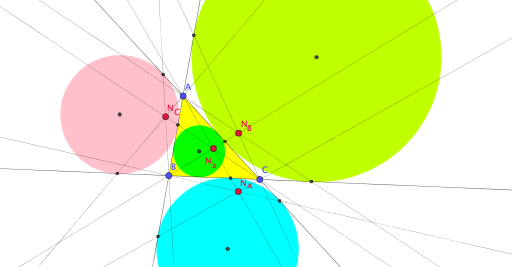
This example demonstrates the geometric relationships and properties of incircles, excircles, and Nagel points in a triangle. Core concepts include triangles, circles, angle bisectors, intersections, perpendicular lines, and polygon constructions. It is constructed using commands like Line, AngularBisector, Intersect, OrthogonalLine, Circle, and Polygon, making it suitable for high school geometry education and construction learning.
GeoGebra Commands & Parameters
Line(A, B) → fLine(B, C) → gLine(C, A) → hAngularBisector(f, h) → i, jAngularBisector(f, g) → k, lAngularBisector(h, g) → m, nIntersect(i, k) → E_CIntersect(j, l) → IIntersect(i, l) → E_BIntersect(j, k) → E_AOrthogonalLine(E_C, f) → pOrthogonalLine(I, f) → qOrthogonalLine(E_A, f) → rOrthogonalLine(E_B, f) → sIntersect(f, s) → HIntersect(f, p) → C'Intersect(f, q) → JIntersect(f, r) → KOrthogonalLine(E_C, h) → tOrthogonalLine(I, h) → aOrthogonalLine(E_B, h) → bOrthogonalLine(E_A, h) → cIntersect(h, t) → LIntersect(h, a) → MIntersect(h, b) → B'Intersect(h, c) → OOrthogonalLine(E_C, g) → dOrthogonalLine(I, g) → eOrthogonalLine(E_A, g) → f_1OrthogonalLine(E_B, g) → g_1Intersect(g, d) → PIntersect(g, e) → QIntersect(g, f_1) → A'Intersect(g, g_1) → SCircle(E_C, L) → c_1Circle(E_B, B') → d_1Circle(I, M) → e_1Circle(E_A, O) → h_1Polygon(A, B, C) → t1, c_2, a_1, b_1Line(L, B) → i_1Line(P, A) → j_1Line(C, C') → k_1Line(A, S) → l_1Line(C, H) → m_1Line(B, B') → n_1Intersect(i_1, j_1) → N_CIntersect(l_1, m_1) → N_BLine(B, O) → p_1Line(C, K) → q_1Line(A, A') → r_1Intersect(p_1, q_1) → N_AIntersect(k_1, n_1) → N_a
AI Drawing Prompt Reference
Draw a triangle with its three sides and construct the angle bisectors of the triangle (the three pairs of bisectors are intersected pairwise to obtain the key intersection points). From each such bisector intersection, drop perpendicular lines to the corresponding triangle side, then take the intersections with the relevant sides/lines to create the corresponding foot-related points. Construct several circles: each circle is determined by a chosen center at one of the intersection-derived points together with a second point obtained from those perpendicular constructions, so the radius is fixed by two points. Connect the main constructed points to the appropriate triangle vertices and intersections, and include the polygon formed by the three original triangle vertices to complete the incircle–excircle–Nagel-point style configuration.
The prompt above was compiled from the original drawing commands and is for reference only.