
Impact of Changes on Polygon Area
Loading the math board and drawing, please wait…
In collections
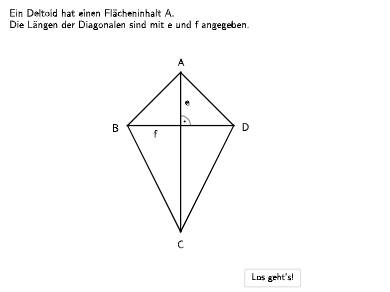
Deltoid - Flächeninhalt und Umkehraufgaben
This GeoGebra example dynamically demonstrates how area changes when parameters of polygons are modified. Key mathematical concepts include area formulas for parallelograms, trapezoids, rhombuses, and deltoids. Construction highlights: Polygon command for drawing quadrilaterals, Translate for transformations, If and Intersect for conditional logic and intersection points, Angle for angle measurements, Textfield and InputBox for user input and answer validation. Suitable for grades 5-6 students to understand and apply area formulas of special quadrilaterals.
GeoGebra Commands & Parameters
Textfield(input1) → InputBox1Textfield(input2) → InputBox2Shuffle({1, 2, 3, 4}) → PermutationList, {3, 4, 1, 2}Polygon(PtopLeftCornerFeedback, PtopRightCornerFeedback, PbottomRightCornerFeedback, PbottomLeftCornerFeedback) → rectangleCorrect, rectangleCorrectS3, rectangleCorrectS4, rectangleCorrectS2, rectangleCorrectS1Shuffle(Sequence[Random[0, 10], i, 1, 100]) → randomNosForX, {7, 1, 7, 2, 10, 1, 10, 3, 3, 9, 9, 3, 8, 10, 8, 3, 5, 5, 8, 1, 1, 10, 9, 6, 0, 8, 3, 5, 9, 2, 9, 7, 0, 9, 0, 5, 10, 6, 0, 8, 7, 3, 6, 1, 8, 9, 3, 7, 5, 5, 7, 4, 0, 2, 8, 6, 9, 3, 8, 7, 6, 3, 5, 9, 6, 9, 5, 8, 10, 7, 3, 2, 4, 2, 7, 7, 9, 7, 5, 9, 0, 9, 5, 0, 4, 5, 2, 5, 1, 10, 5, 8, 7, 9, 7, 8, 4, 7, 1, 7}Element(randomNosForX, Mod[questionCount, 100] + 1) → numXShuffle(Sequence[Random[0, 10], i, 1, 100]) → randomNosForY, {4, 7, 9, 1, 7, 5, 4, 10, 8, 10, 8, 2, 9, 3, 8, 10, 0, 3, 6, 7, 9, 4, 3, 1, 8, 5, 4, 0, 7, 1, 4, 2, 6, 8, 10, 10, 10, 6, 4, 0, 9, 4, 4, 10, 4, 4, 7, 9, 9, 4, 1, 9, 8, 6, 6, 7, 2, 6, 2, 0, 1, 9, 2, 1, 3, 9, 10, 2, 0, 1, 9, 7, 10, 2, 0, 7, 2, 5, 5, 5, 10, 7, 4, 2, 8, 1, 7, 7, 8, 10, 4, 2, 7, 9, 5, 8, 1, 2, 1, 9}Element(randomNosForY, Mod[questionCount, 100] + 1) → numYAppend(true, Sequence[If[randomNosForX(i) ≟ randomNosForX(i - 1), false, true], i, 2, 100]) → stayXAppend(true, Sequence[If[randomNosForY(i) ≟ randomNosForY(i - 1), false, true], i, 2, 100]) → stayYRemove(Sequence[If[stayX(i), randomNosForX(i), 0], i, 1, 100], Sequence[0, i, 1, 100]) → randomNosForXwithoutRepeatRemove(Sequence[If[stayY(i), randomNosForY(i), 0], i, 1, 100], Sequence[0, i, 1, 100]) → randomNosForYwithoutRepeatElement(randomNosForXwithoutRepeat, Mod[questionCount, Length[randomNosForXwithoutRepeat]] + 1) → numXwithoutRepeatElement(randomNosForYwithoutRepeat, Mod[questionCount, Length[randomNosForYwithoutRepeat]] + 1) → numYwithoutRepeatShuffle(Sequence[i, i, 1, 15]) → ExNumList, {1, 11, 6, 14, 13, 2, 7, 12, 4, 8, 3, 15, 5, 9, 10}Join({{2}, ExNumList \ {2, 13, 9, 8, 6, 4}}) → ExNumListRealTranslate(VR1, (0, (-distVR))) → VR2Translate(VR2, (0, (-distVR))) → VR3Translate(VR3, (0, (-distVR))) → VR4If(exNum ∈ {1, 2, 5, 7, 8, 11, 12, 15}, 1, exNum ∈ {3, 6, 10}, 2, exNum ∈ {4, 9, 13, 14}, 3) → modusIntersect(Segment[A, B], Segment[E, J]) → KAngle(E, K, A) → α
AI Drawing Prompt Reference
Draw a polygon containing a rectangle and four triangles. The vertices of the rectangle are determined by four random points, and the vertices of the triangles are also determined by random points. The base of the triangles is parallel to the sides of the rectangle, and the height of the triangles is parallel to the height of the rectangle. Draw the height and base of the triangles, draw the area of the rectangle, draw the area of the triangles, draw a point representing the ratio of the area of the triangles to the area of the rectangle, draw a line segment representing the ratio of the height of the triangles to the height of the rectangle, and draw an angle representing the difference between the angles of the triangles and the rectangle.
The prompt above was compiled from the original drawing commands and is for reference only.