
Illustration of a Proof of Pythagoras' Theorem
Loading the math board and drawing, please wait…
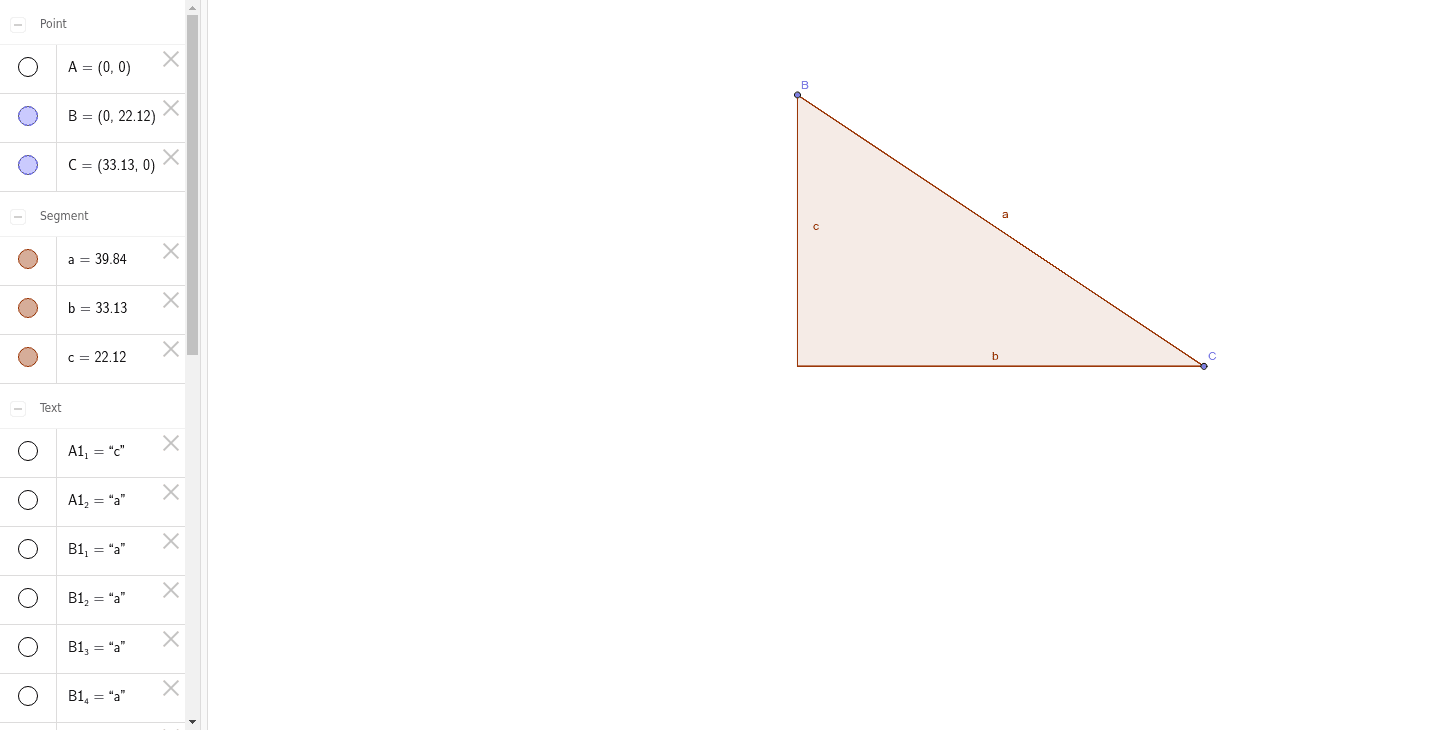
This example demonstrates Pythagoras' Theorem through geometric figures. It involves the relationship between the sides of a right-angled triangle. By constructing multiple polygons and using the translate command, it intuitively proves that the square of the hypotenuse equals the sum of the squares of the other two sides. Suitable for students at junior high school level and above.
GeoGebra Commands & Parameters
Intersect(xAxis, yAxis) → APoint(yAxis) → BPoint(xAxis) → CPolygon(A, B, C) → poly1, c, a, bTranslate(Polygon[Rotate[A, -1.5707963267948966, Vertex[poly1, 3]], Rotate[B, -1.5707963267948966, Vertex[poly1, 3]], Rotate[C, -1.5707963267948966, Vertex[poly1, 3]]], Segment[Vertex[poly1, 3], Vertex[poly1, 2]]) → poly2Translate(Rotate[poly2, -1.5707963267948966, Vertex[poly2, 3]], Segment[Vertex[poly2, 3], Vertex[poly2, 2]]) → poly3Translate(Rotate[poly3, -1.5707963267948966, Vertex[poly3, 3]], Segment[Vertex[poly3, 3], Vertex[poly3, 2]]) → poly4Name(c) → A1_1Name(a) → B1_1Name(b) → C1_1Name(c) → D1_1Name(a) → B1_2Name(c) → D1_2Name(a) → B1_3Name(c) → D1_3Name(a) → B1_4Name(b) → C1_2Name(a) → B1_5Name(c) → D1_4Name(b) → C1_3Name(c) → D1_5Name(a) → A1_2Name(b) → B1_6Name(c) → C1_4
AI Drawing Prompt Reference
Draw a right-angled triangle and demonstrate the Pythagorean theorem. Start by plotting the intersection of the x and y axes, and points on each axis to form the triangle. Then, rotate and translate this triangle to create multiple similar polygons, visually showing that the square of the hypotenuse equals the sum of the squares of the other two sides.
The prompt above was compiled from the original drawing commands and is for reference only.