
Hyperbolic Tetrahedron and Circle-Tetrahedron Construction
Loading the math board and drawing, please wait…
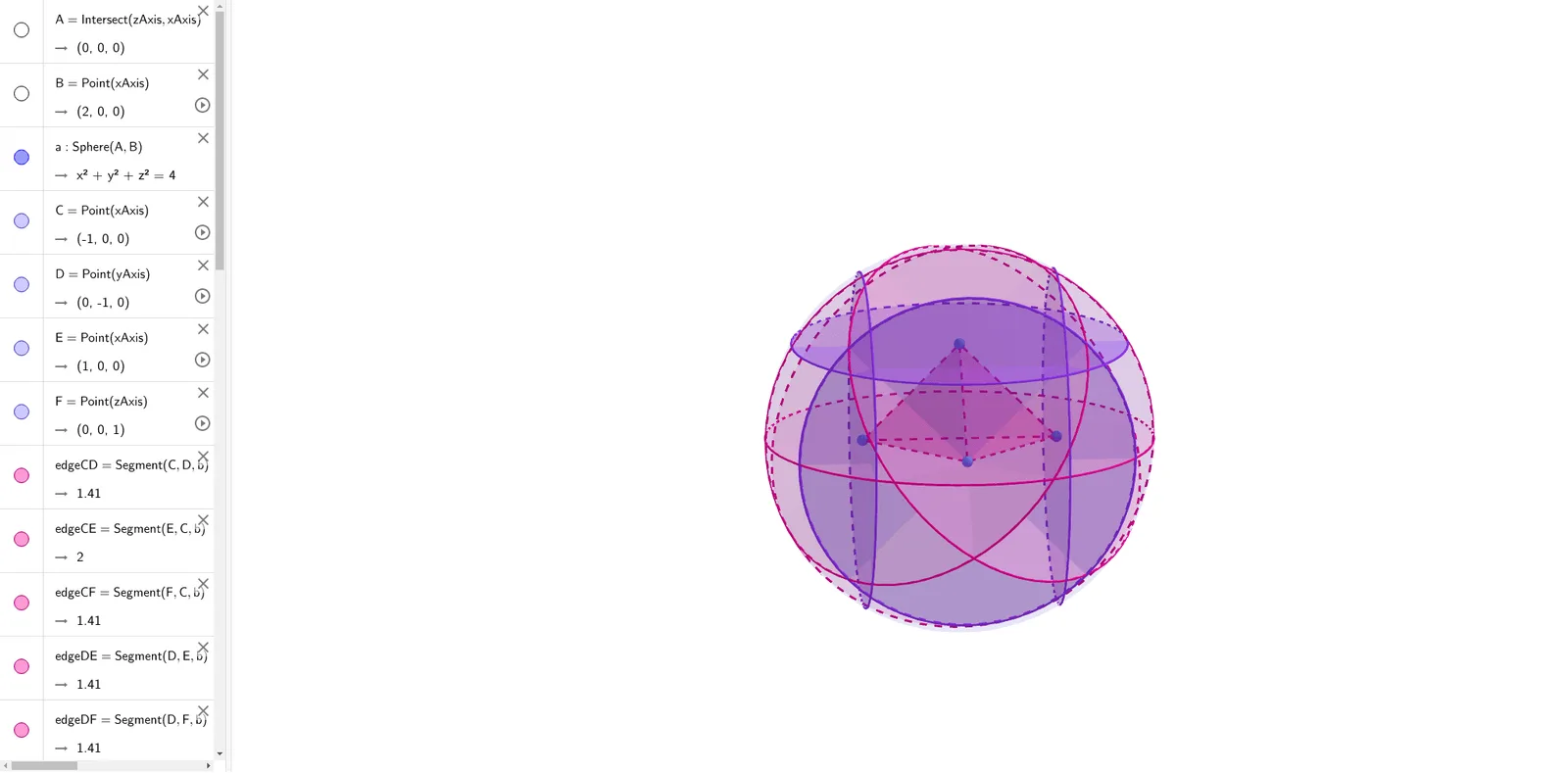
① This example demonstrates the construction of a hyperbolic tetrahedron and its associated circle-tetrahedron in 3D space, illustrating the relationship between hyperbolic geometry and Euclidean polyhedral structures. ② Core mathematical concepts include hyperbolic geometry, tetrahedra, intersections of spheres and planes, orthogonal planes, faces and edges of polyhedra, and the geometric properties of circles in 3D. ③ Construction details: Uses GeoGebra commands such as Intersect (to find intersection points), Point (to define vertices), Sphere (to create spheres), Pyramid (to build pyramids), Plane (to define planes), IntersectPath (to compute intersection paths), and OrthogonalPlane (to construct orthogonal planes). Objects include vertices A, B, C, D, E, F, faces like faceCDE, edges like edgeCD, and auxiliary lines c, d, e, etc. ④ Suitable for high school to university-level geometry teaching, especially for visual demonstrations of hyperbolic geometry, polyhedra, and spherical geometry, as well as for mathematical modeling or computer-aided geometric design.
GeoGebra Commands & Parameters
Intersect(zAxis, xAxis) → APoint(xAxis) → BSphere(A, B) → aPoint(xAxis) → CPoint(yAxis) → DPoint(xAxis) → EPoint(zAxis) → FPyramid(C, D, E, F) → b, faceCDE, edgeEF, faceCDF, faceDEF, faceCEF, edgeCD, edgeDE, edgeCE, edgeCF, edgeDFPlane(F, D, E) → cIntersectPath(c, a) → dPlane(F, D, C) → eIntersectPath(e, a) → fPlane(C, D, E) → gIntersectPath(g, a) → hPlane(C, F, E) → iIntersectPath(i, a) → kOrthogonalPlane(D, yAxis) → jIntersectPath(j, a) → pOrthogonalPlane(E, xAxis) → lIntersectPath(l, a) → qOrthogonalPlane(C, xAxis) → mIntersectPath(m, a) → rOrthogonalPlane(F, zAxis) → nIntersectPath(n, a) → s