
Hyperbola Reflective Property Demonstration
Loading the math board and drawing, please wait…
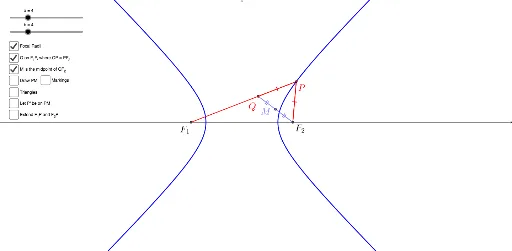
①This example dynamically demonstrates the reflective property of a hyperbola: a ray emanating from one focus, after reflecting off the hyperbola, appears to come from the other focus. ②The core mathematical concept is the optical property of the hyperbola, where the difference of distances from any point on the hyperbola to the two foci is constant, and the tangent at that point bisects the angle between the focal radii, satisfying the law of reflection. ③Construction details: Using GeoGebra commands such as Segment, Point, Circle, Intersect, Midpoint, Line, Polygon, Angle, and Ray, the hyperbola with foci F_1, F_2 and vertices V_1, V_2 is constructed, along with incident and reflected rays and the normal line; angle labels and text annotations clarify the reflection relationship. Objects include b, a, c, E, D, j, P, Q, M, and auxiliary circles and polygons. ④Suitable for high school or college analytic geometry and conic sections courses, to understand the optical property of hyperbolas and geometric construction methods, and as material for mathematical experiments or inquiry-based learning.
GeoGebra Commands & Parameters
Segment(E, D) → jPoint(d) → PSegment(F_1, P) → eSegment(P, F_2) → fCircle(P, F_2) → hIntersect(h, e, 1) → QSegment(P, Q) → iSegment(P, F_2) → mSegment(Q, F_2) → nMidpoint(n) → MLine(P, M) → qPolygon(Q, P, M) → poly1, c_1, b_1, a_1Polygon(M, P, F_2) → poly2, f_2, c_2, a_2Segment(M, Q) → rSegment(M, F_2) → sAngle(P, M, Q) → αPoint(q) → P'Segment(F_2, P') → tSegment(P', Q) → d_1Segment(F_1, P') → e_1Angle(Q, P, M) → βAngle(M, P, F_2) → γRay(F_1, P) → f_1Point(f_1) → APoint(q) → BAngle(A, P, B) → δRay(F_2, P) → g_1Point(g_1) → CAngle(B, P, C) → ε