
Humber Circuit Board Project: Area Optimization and Random Variables
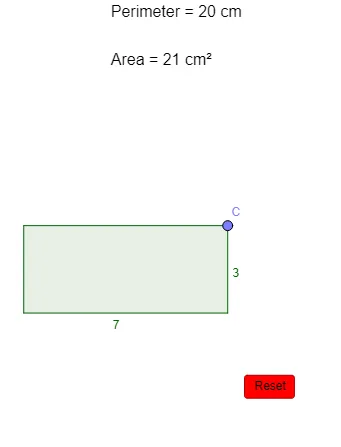
Loading the math board and drawing, please wait…
① This interactive GeoGebra example, titled 'Humber Circuit Board Project', demonstrates the mathematical modeling of a circuit board-shaped polygon, including area calculation, random point sampling, and optimization of layout within the region. ② Core mathematical concepts include area and perimeter computation, optimization problems, random variables (used to generate random points), parabolas, tangent lines, the unit circle, and pie/circle charts for data visualization, integrating algebra, geometry, and probability/statistics. ③ Construction details: The example uses GeoGebra commands such as Point, Segment, Polygon, Perimeter, and PointIn to construct the polygon and its boundary; lists (datax, datay, dataarea) store random point coordinates and area data, visualized via pie or circle charts; interactive buttons (button1, button2) control actions, and text objects (text1) display results. Key objects include points A, B, C, D, DD, function f, polygon poly1, lines g and h, circle c, and auxiliary points A1, B1, C1. ④ This resource is suitable for high school or early college students, ideal for project-based learning that combines geometric construction, optimization thinking, and random simulation to develop comprehensive skills in applying GeoGebra to real-world engineering problems.
GeoGebra Commands & Parameters
Point(yAxis) → APoint(xAxis) → BSegment(A, B) → fPoint(f) → CPolygon((0, 0), (x(C), 0), C, (0, y(C))) → poly1, g, h, c, iPerimeter(poly1) → perimeterpoly1PointIn(poly1) → Pointpoly1_1PointIn(poly1) → Pointpoly1