
How to Play the Game
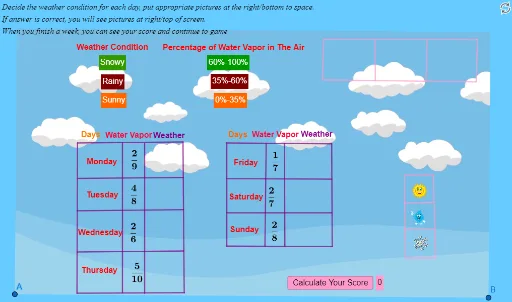
Loading the math board and drawing, please wait…
This example demonstrates an interactive game based on geometric transformations, generating polygons randomly and determining if points lie within regions. Core math concepts include geometric transformations, polygon construction, region testing, and parametric equations. It utilizes commands like Random, Polygon, IsInRegion, Segment, Point, and If, as well as objects like segments and points, from GeoGebra's construction summary. Suitable for high school students learning geometric transformations, parametric equations, and analytical geometry, it serves as an engaging teaching tool and learning resource.
GeoGebra Commands & Parameters
Random(0, 5) → ıRandom(0, 5) → kRandom(5, 10) → iRandom(5, 10) → mRandom(0, 5) → aaRandom(5, 10) → abRandom(0, 5) → acRandom(5, 10) → adRandom(0, 5) → alRandom(5, 10) → rkRandom(0, 5) → öyRandom(5, 10) → rbRandom(0, 5) → gyRandom(5, 10) → syPolygon(T, U, 4) → poly1, h, n, p, q, V, WPolygon(Z, A_1, 4) → poly2, t, a, b, c, B_1, C_1Polygon(D_1, E_1, 4) → poly3, d, f_1, g_1, h_1, F_1, G_1Polygon(H_1, I_1, 4) → poly4, j_1, k_1, l_1, m_1, J_1, K_1Polygon(L_1, M_1, 4) → poly5, n_1, p_1, q_1, r_1, N_1, O_1Polygon(P_1, Q_1, 4) → poly6, s_1, t_1, a_1, b_1, R_1, S_1Polygon(T_1, U_1, 4) → poly7, c_1, d_1, e_1, f_2, V_1, W_1IsInRegion(M, poly1) → haIsInRegion(G, poly1) → hbIsInRegion(C_2, poly1) → hcIsInRegion(M, poly2) → hdIsInRegion(G, poly2) → heIsInRegion(C_2, poly2) → hfIsInRegion(M, poly3) → hkIsInRegion(G, poly3) → hlIsInRegion(C_2, poly3) → hmIsInRegion(M, poly4) → hnIsInRegion(G, poly4) → hoIsInRegion(C_2, poly4) → hpIsInRegion(M, poly5) → hrIsInRegion(G, poly5) → hsIsInRegion(C_2, poly5) → htIsInRegion(M, poly6) → huIsInRegion(G, poly6) → hvIsInRegion(C_2, poly6) → hyIsInRegion(M, poly7) → hzIsInRegion(G, poly7) → hxIsInRegion(C_2, poly7) → hwSegment(A_2, E_2) → g_2Point(g_2) → K_2Point(g_2) → M_2Point(g_2) → O_2Segment(G_2, H_2) → eSegment(I_2, H_1) → h_2Segment(J_2, Q_2) → j_2Segment(R_2, S_2) → k_2Segment(T_2, U_2) → p_2Segment(W_2, V_2) → q_2Segment(A_2, J_2) → r_2Segment(E_2, Q_2) → s_2Point(j_2) → A_3Segment(K_2, A_3) → l_2Point(k_2) → B_3Point(k_2) → H_3Point(j_2) → D_3Segment(M_2, D_3) → m_2Point(j_2) → E_3Segment(O_2, E_3) → n_2Point(k_2) → F_3If(hb ≠ 0 ∧ 0 ≤ f ≤ 0.35, Sum[{azö, 1}]) → c_9Random(1, 10) → lPoint(k_2) → L_2Segment(L_2, N_2) → i_2Segment(N_2, P_2) → t_2Point(k_2) → Z_2Segment(P_2, Z_2) → b_2Point(k_2) → C_3Point(t_2) → G_3Segment(C_3, G_3) → c_2Point(k_2) → I_3Point(t_2) → T_3Segment(I_3, T_3) → d_2Segment(E, F) → gSegment(F, I) → jSegment(I, J) → rSegment(J, E) → i_1Point(g) → KPoint(r) → QSegment(K, Q) → e_2Point(g) → SPoint(r) → Z_1Segment(S, Z_1) → f_3Segment(J_3, K_3) → sSegment(K_3, L_3) → a_2Segment(L_3, O_3) → g_3Segment(O_3, J_3) → h_3Point(a_2) → P_3Point(h_3) → Q_3Segment(P_3, Q_3) → i_3Point(a_2) → R_3Point(h_3) → S_3Segment(R_3, S_3) → j_3
AI Drawing Prompt Reference
Create a game based on geometric transformations by randomly generating multiple quadrilaterals and checking if given points lie within these quadrilaterals. First, randomly generate coordinates for points, then draw seven quadrilaterals in sequence, and finally check if each quadrilateral contains the specified points.
The prompt above was compiled from the original drawing commands and is for reference only.