
Homothety and Reflection about a Point
Loading the math board and drawing, please wait…
In collections
Homothety, Rotation Symmetry -RO
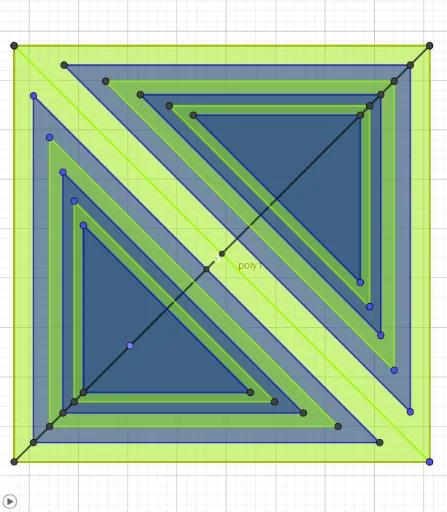
This example demonstrates homothety and reflection about a point. Key mathematical concepts include homothety, reflection, and geometric construction. Using GeoGebra commands such as Polygon, Segment, Dilate, and Mirror, the construction of homothety and reflection about a point is illustrated. Suitable for middle school and above students or teachers.
GeoGebra Commands & Parameters
Polygon(A, B, 4) → poly1, f, g, h, i, C, DSegment(A, C) → jMidpoint(A, C) → EPoint(j) → FPolygon(B, D, C) → t1, c, b, dDilate(B, 5 / 6, F) → B'Dilate(D, 5 / 6, F) → D'Dilate(C, 5 / 6, F) → C'Polygon(B', D', C') → t1', c', b', d'Dilate(B', 5 / 6, F) → B''Dilate(D', 5 / 6, F) → D''Dilate(C', 5 / 6, F) → C''Polygon(B'', D'', C'') → t1'', c'', b'', d''Dilate(B'', 5 / 6, F) → B'''Dilate(D'', 5 / 6, F) → D'''Dilate(C'', 5 / 6, F) → C'''Polygon(B''', D''', C''') → t1''', c''', b''', d'''Dilate(B''', 5 / 6, F) → GDilate(D''', 5 / 6, F) → HDilate(C''', 5 / 6, F) → IPolygon(G, H, I) → t2, i_1, g_1, h_1Dilate(G, 5 / 6, F) → G'Dilate(H, 5 / 6, F) → H'Dilate(I, 5 / 6, F) → I'Polygon(G', H', I') → t2', i', g', h'Mirror(B, E) → B'_1Mirror(D, E) → D'_1Mirror(C, E) → C'_1Polygon(B'_1, D'_1, C'_1) → t1'_1, c'_1, b'_1, d'_1Mirror(B', E) → B''_1Mirror(D', E) → D''_1Mirror(C', E) → C''_1Polygon(B''_1, D''_1, C''_1) → t1''_1, c''_1, b''_1, d''_1Mirror(B'', E) → B'''_1Mirror(D'', E) → D'''_1Mirror(C'', E) → C'''_1Polygon(B'''_1, D'''_1, C'''_1) → t1'''_1, c'''_1, b'''_1, d'''_1Mirror(B''', E) → JMirror(D''', E) → KMirror(C''', E) → LPolygon(J, K, L) → t3, l, j_1, kMirror(G, E) → G'_1Mirror(H, E) → H'_1Mirror(I, E) → I'_1Polygon(G'_1, H'_1, I'_1) → t2'_1, i'_1, g'_1, h'_1Mirror(G', E) → G''Mirror(H', E) → H''Mirror(I', E) → I''Polygon(G'', H'', I'') → t2'', i'', g'', h''Dilate(E, 5 / 6, F) → E'
AI Drawing Prompt Reference
Draw a quadrilateral and find the midpoint of one of its diagonals. Use this midpoint as the center to perform multiple dilations and reflections on the quadrilateral, demonstrating the effects of these transformations. First, dilate the quadrilateral to 5/6 of its original size, then repeat this dilation multiple times, each time scaling the previous result to 5/6. Next, reflect the original quadrilateral across the midpoint of the diagonal, repeating this reflection multiple times to show the effects of reflection.
The prompt above was compiled from the original drawing commands and is for reference only.