
HL Exploration: Dynamic Construction of Right Triangle Congruence
Loading the math board and drawing, please wait…
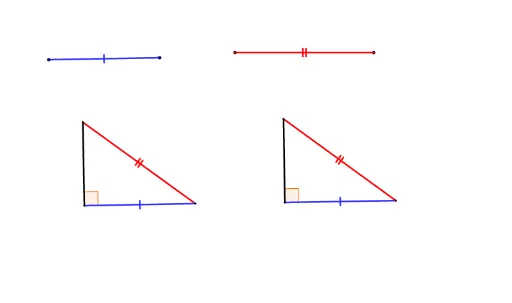
This GeoGebra example demonstrates the Hypotenuse-Leg (HL) congruence theorem for right triangles through dynamic geometric construction. The core mathematical concept is triangle congruence, specifically the HL criterion unique to right triangles, along with related topics such as similarity transformations, parallelograms, conic sections, Poisson distribution, and median values. The construction uses commands including Segment, Line, OrthogonalLine, Circle, Intersect, and Angle, involving multiple points (A, B, C, D, etc.), segments (f, g, h, etc.), circles (c, d, c_1), and angles (α, β). By dynamically adjusting the lengths of the hypotenuse and one leg, learners can visually verify that two right triangles are always congruent when their hypotenuse and one corresponding leg are equal. This example is suitable for middle or high school geometry classes, serving as an interactive tool for teachers to demonstrate the theorem or for students to explore independently, enhancing intuitive understanding of the HL congruence condition through slider manipulation and observation of geometric changes.
GeoGebra Commands & Parameters
Segment(A, B) → fSegment(C, D) → gLine(F, G) → hLine(H, I) → iOrthogonalLine(F, h) → jOrthogonalLine(H, i) → kCircle(F, Segment[B, A]) → cCircle(H, Segment[A, B]) → dIntersect(c, h, 2) → KCircle(K, Segment[C, D]) → eIntersect(d, i, 2) → LCircle(L, Segment[D, C]) → pIntersect(e, j, 2) → MSegment(M, K) → lIntersect(e, k, 2) → NSegment(N, H) → nSegment(H, L) → qSegment(K, F) → rSegment(F, M) → sSegment(H, N) → tCircle(L, Segment[D, C]) → c_1Intersect(c_1, t, 1) → OSegment(L, O) → aSegment(O, H) → bAngle(L, H, O) → αAngle(K, F, M) → β
AI Drawing Prompt Reference
Create a dynamic geometric construction demonstrating the HL congruence theorem for right triangles. Include two right triangles with adjustable hypotenuse and one leg using sliders. Construct the triangles using circles and line segments, highlighting the hypotenuse and legs. Display corresponding sides and angles of the triangles to visually verify that they are congruent when the hypotenuse and one leg are equal.
The prompt above was compiled from the original drawing commands and is for reference only.