
Hinge Theorem Exploration
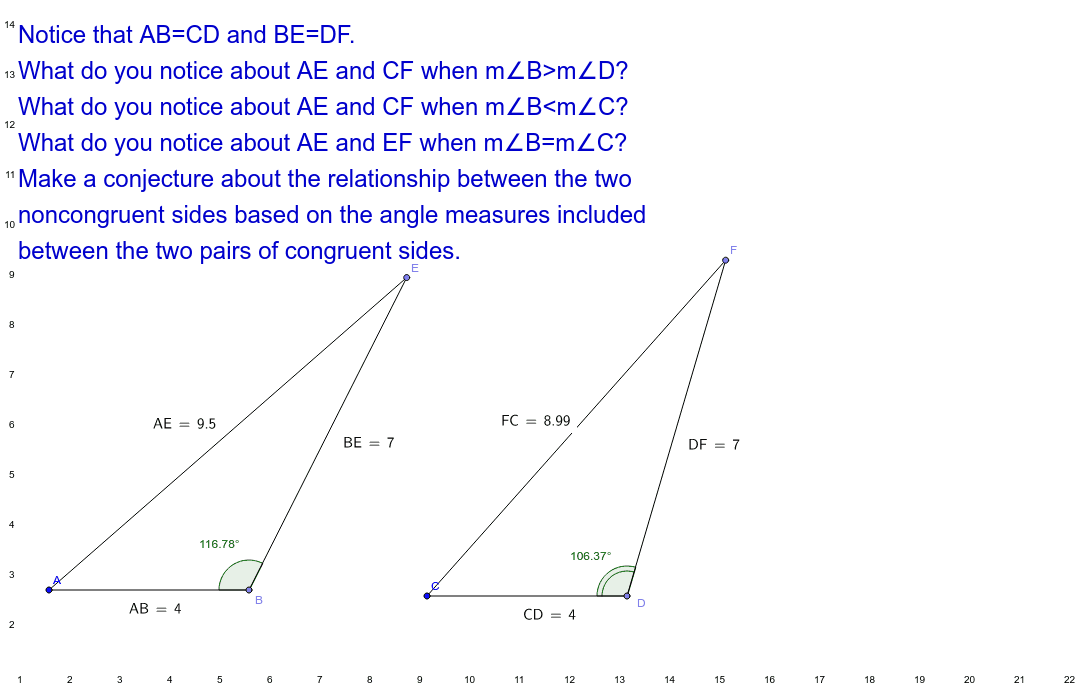
Loading the math board and drawing, please wait…
In collections
Inequalities in a Triangle
This example guides students to explore the Hinge Theorem by examining the relationship between the side lengths and angle measures of a triangle. Key mathematical concepts include the relationship between the sides and angles of a triangle. Using GeoGebra commands such as Point, Segment, Distance, Midpoint, and Angle, students can observe the relationship between the difference in the lengths of two sides of a triangle and the size of the included angle. Suitable for students in middle school and above for geometric construction and triangle properties.
GeoGebra Commands & Parameters
Point(Circle[A, abs(4)]) → BSegment(A, B) → aPoint(Circle[C, abs(4)]) → DSegment(C, D) → bPoint(Circle[B, abs(7)]) → ESegment(B, E) → cPoint(Circle[D, abs(7)]) → FSegment(D, F) → dSegment(A, E) → eSegment(C, F) → fDistance(A, B) → distanceABMidpoint(A, B) →Distance(B, E) → distanceBEMidpoint(B, E) →Distance(C, D) → distanceCDMidpoint(C, D) →Distance(D, F) → distanceDFMidpoint(D, F) →Distance(F, C) → distanceFCMidpoint(F, C) →Distance(A, E) → distanceAEMidpoint(A, E) →Angle(A, B, E) → αAngle(C, D, F) → β
AI Drawing Prompt Reference
Draw a triangle with two sides of lengths 4 and 7, and measure the angles between these sides. Then, draw the perpendicular bisectors of these two sides and observe their relationship with the third side. By changing the lengths of the sides and the included angle, explore the relationship between the side lengths and angles of a triangle to verify the Hinge Theorem.
The prompt above was compiled from the original drawing commands and is for reference only.