
HCF & LCM of Three Numbers by Prime Factorization
Loading the math board and drawing, please wait…
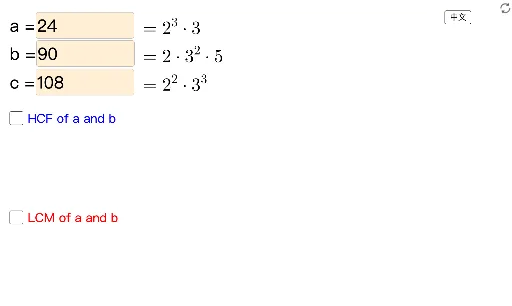
This example demonstrates how to calculate the Highest Common Factor (HCF) and Least Common Multiple (LCM) of three numbers using prime factorization. It involves core mathematical concepts like prime factorization, HCF, and LCM. The construction utilizes GeoGebra commands and objects such as Factors, Unique, Sort, Zip, KeepIf, Product, If, Textfield, and LaTeX to visualize prime factors, compute HCF and LCM, and display results. Suitable for middle school and above students to understand and master the calculation methods of HCF and LCM.
GeoGebra Commands & Parameters
Factors(b) → M2Unique(PrimeFactors[b]) → listBFactors(a) → M1Unique(PrimeFactors[a]) → listAFactors(c) → M3Unique(PrimeFactors[c]) → listCSort(Union[Union[listA, listB], listC]) → listPrimeZip(If[Defined[IndexOf[k, listB]], Element[M2, IndexOf[k, listB], 2], 0], k, listPrime) → listB2Zip(If[Defined[IndexOf[k, listC]], Element[M3, IndexOf[k, listC], 2], 0], k, listPrime) → listC2Zip(If[Defined[IndexOf[k, listA]], Element[M1, IndexOf[k, listA], 2], 0], k, listPrime) → listA2Zip({k, Min[{m, n, p}]}, k, listPrime, m, listA2, n, listB2, p, listC2) → listHCFKeepIf(Element[k, 2] ≠ 0, k, listHCF) → listHCF'Product(Zip[Element[k, 1]^(Element[k, 2]), k, listHCF']) → resultHCFIf(listHCF' ≟ {}, 1, resultHCF) → resultHCF'Zip(((Element[p, 1] * If[Element[p, 2] ≠ 1, (("^{" * Element[p, 2]) * "}")]) * If[{p} ≠ Last[M1], UnicodeToLetter[8901], ""]), p, M1) → listTextATextfield(a) → inputBox1Zip(((Element[p, 1] * If[Element[p, 2] ≠ 1, (("^{" * Element[p, 2]) * "}")]) * If[{p} ≠ Last[M2], UnicodeToLetter[8901], ""]), p, M2) → listTextBTextfield(b) → inputBox2Zip(((Element[p, 1] * If[Element[p, 2] ≠ 1, (("^{" * Element[p, 2]) * "}")]) * If[{p} ≠ Last[listHCF'], UnicodeToLetter[8901], ""]), p, listHCF') → listTextHCFZip({k, Max[{m, n, p}]}, k, listPrime, m, listA2, n, listB2, p, listC2) → listLCMZip(((Element[p, 1] * If[Element[p, 2] ≠ 1, (("^{" * Element[p, 2]) * "}")]) * If[{p} ≠ Last[listLCM], UnicodeToLetter[8901], ""]), p, listLCM) → listTextLCMLaTeX("\text{LCM= }" + (Sum[listTextLCM])) → textLCMTextfield(c) → inputBox3Zip(((Element[p, 1] * If[Element[p, 2] ≠ 1, (("^{" * Element[p, 2]) * "}")]) * If[{p} ≠ Last[M3], UnicodeToLetter[8901], ""]), p, M3) → listTextCProduct(Zip[Element[k, 1]^(Element[k, 2]), k, listLCM]) → resultLCM
AI Drawing Prompt Reference
Illustrate the prime factorization of three numbers and calculate their highest common factor (HCF) and least common multiple (LCM). First, factorize each number into prime factors and identify all unique prime factors. Then, calculate the HCF by taking the minimum power of common prime factors across all numbers, and the LCM by taking the maximum power of all prime factors. Finally, display the prime factorization of each number, the HCF, and the LCM using text.
The prompt above was compiled from the original drawing commands and is for reference only.