
Harmonic Addition 1
Loading the math board and drawing, please wait…
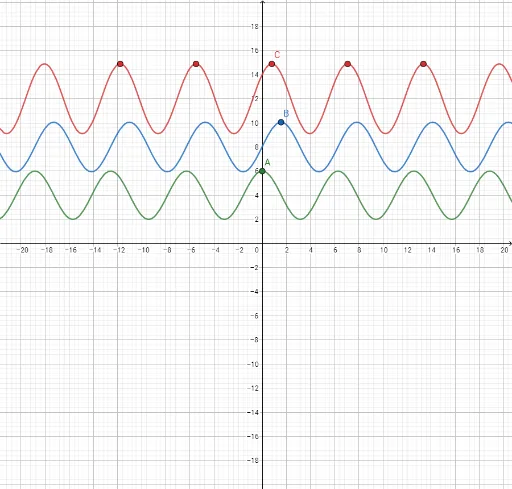
This example demonstrates harmonic addition. It involves trigonometric functions and vectors. Using GeoGebra commands such as objects, angles, and functions, complex harmonic addition graphics can be constructed. Suitable for high school mathematics education and learning.
GeoGebra Commands & Parameters
Point A(0, 6)Point B(1.5527791385400052, 10.053023687599998)Numeric a_{offset}(4)Numeric b_{offset}(8)a_{offset} + b_{offset}y(A) - a_{offset}y(B) - b_{offset}x(A)x(B)(a * cos(α))(a * sin(α))(b * cos(β))(b * sin(β))x_{A} + x_{B}y_{A} + y_{B}sqrt(x_{C}^(2) + y_{C}^(2))atan2(y_{C},x_{C})f(x) = (a * cos(x - α)) + a_{offset}g(x) = (b * cos(x - β)) + b_{offset}h(x) = (c * cos(x - θ)) + c_{offset}(θ, c + c_{offset})(θ + (2 * π), c + c_{offset})(θ - (2 * π), c + c_{offset})(θ + (4 * π), c + c_{offset})(θ - (4 * π), c + c_{offset})
AI Drawing Prompt Reference
Draw a coordinate plane illustrating harmonic addition. Place two points, one above the vertical axis and another to the upper right, and set two numeric vertical offsets. From these points, draw two cosine curves whose amplitudes and phases are determined by the point coordinates and offsets, with each curve shifted vertically. Then draw a third curve whose amplitude and phase are computed from the sum of the horizontal and vertical components of the first two curves, also vertically shifted. Finally, mark a series of points at the peak positions of the third curve, spaced at periodic intervals along the horizontal axis, to highlight the resulting waveform.
The prompt above was compiled from the original drawing commands and is for reference only.