
Half Sphere Model of Projective Plane
Loading the math board and drawing, please wait…
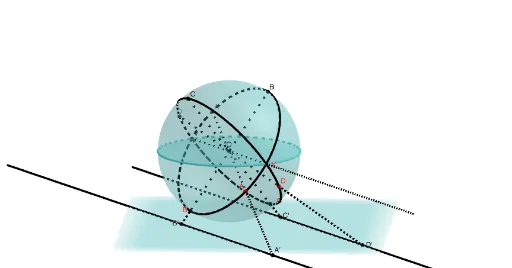
This example demonstrates the half-sphere model of the projective plane, illustrating how the projective plane can be visualized as a hemisphere with antipodal points on the boundary identified. The core mathematical concepts include projective geometry, topological identification, parametrization of spheres and hemispheres, and the correspondence of points, lines, and circles in the projective plane. Construction highlights: using GeoGebra commands such as Point, Plane, Sphere, PointIn, Line, Intersect, Circle, CircumcircleArc, Segment, and Ray, the model builds a hemisphere, boundary circle, interior points, intersections of lines and circles, arcs, and segments, with numerous auxiliary objects (O, D, C, B_1, b, a, L, h, N, etc.). Suitable for university-level geometry courses or advanced students to grasp the abstract concept of the projective plane, and useful for introductory topology demonstrations.
GeoGebra Commands & Parameters
Point(zAxis) → OPoint(xAxis) → DPoint(yAxis) → CPoint(xAxis) → B_1Plane(B_1, C, D) → bSphere(O, 1) → aPointIn(a) → LLine(O, L) → hIntersect(h, a) → N, O_1PointIn(a) → ECircle(zAxis, E) → cPoint(c) → VCircle(N, V, L) → BPoint(B) → V_1Line(O, V_1) → jIntersect(j, B, 2) → FIntersect(j, b) → A'Line(O, E) → fLine(V, O) → gIntersect(xAxis, zAxis) → GIntersect(f, c, 1) → HIntersect(f, c, 2) → ICircumcircleArc(E, G, I) → dIntersect(g, c, 2) → JIntersect(g, c, 1) → KCircumcircleArc(V, G, K) → eIntersect(h, c) → M, PPointIn(a) → QLine(Q, O) → iIntersect(i, a) → R, SCircle(S, V, Q) → pIntersect(h, b) → TIntersect(i, b) → ULine(A', T) → lPoint(p) → ZLine(O, Z) → mIntersect(m, b) → A_1Segment(F, A') → qLine(U, A_1) → nCircumcircleArc(V, Q, K) → c_1CircumcircleArc(V, L, K) → d_1Circle(L, Q, E) → e_1Intersect(m, p, 2) → ASegment(N, T) → rSegment(A, A_1) → tIntersect(c, d_1, 1) → WRay(W, V) → f_1Segment(U, S) → s
AI Drawing Prompt Reference
Draw a hemisphere with its boundary as a circle, showing antipodal points on the boundary. Place several points and lines inside the hemisphere, highlighting intersections of lines and circles, arcs, and segments. Construct a great circle passing through the center of the hemisphere, marking points on its surface and boundary. Lines from these points intersect the great circle, forming multiple intersection points. Finally, connect some points with arcs to illustrate the relationship between the hemisphere and the projective plane.
The prompt above was compiled from the original drawing commands and is for reference only.