
Graphing Quadratic Functions by GreenMaths
Loading the math board and drawing, please wait…
In collections
Patterns & Equations
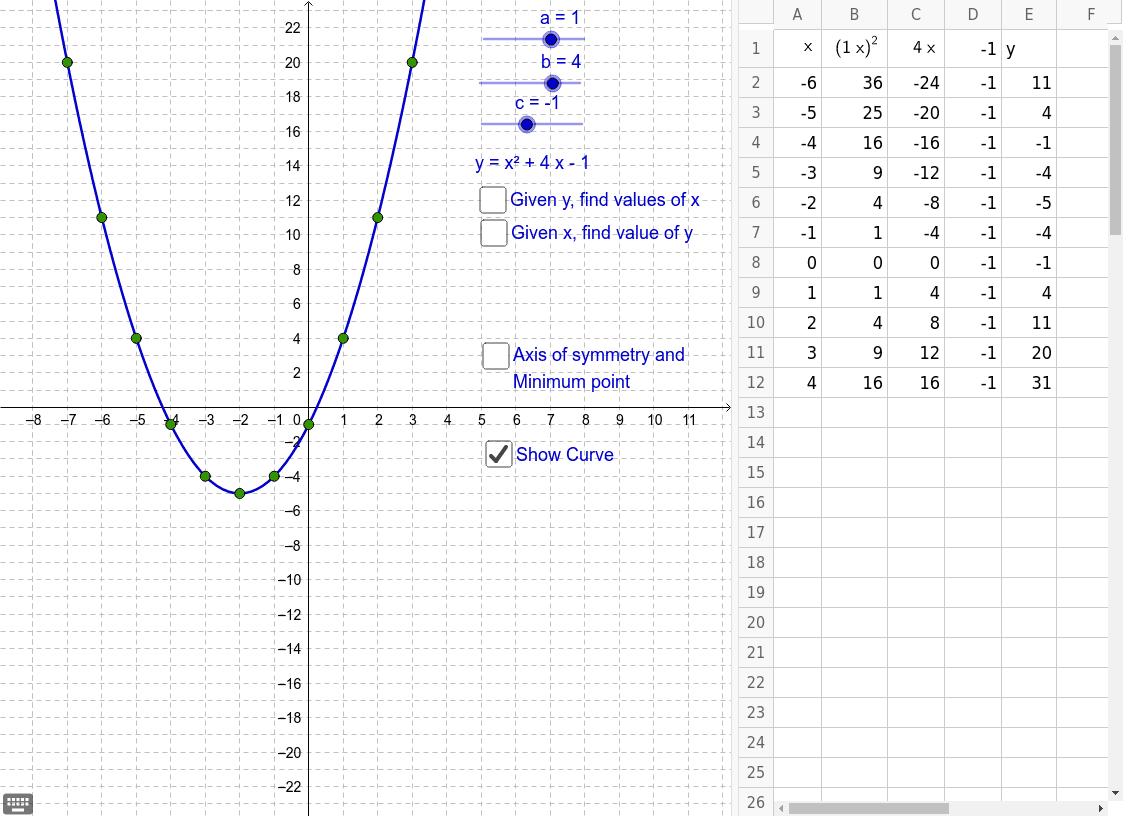
This example demonstrates how to graph any quadratic function. It allows finding the corresponding y value for a given x value and vice versa. The axis of symmetry is also identified. Commands used include Point, Intersect, OrthogonalLine, Segment, Midpoint, Sum, etc. Suitable for students learning about quadratic functions from middle school onwards.
GeoGebra Commands & Parameters
Point(yAxis) → RPoint(f) → AIntersect(f, yAxis, 1) → BPoint(f) → CPoint(f) → DPoint(f) → EPoint(f) → FPoint(f) → GPoint(f) → HPoint(f) → IPoint(f) → JPoint(f) → KPoint(f) → LOrthogonalLine(R, yAxis) → lIntersect(f, l, 1) → SOrthogonalLine(S, xAxis) → mIntersect(m, xAxis) → USegment(S, U) → pPoint(xAxis) → MOrthogonalLine(M, xAxis) → gIntersect(f, g, 1) → NOrthogonalLine(N, yAxis) → hIntersect(h, yAxis) → OSegment(M, N) → iSegment(N, O) → jMidpoint(F, G) → PPoint(f) → WPoint(f) → ZPoint(f) → A_1Point(f) → B_1Point(f) → C_1Point(f) → D_1Intersect(p_1, xAxis, 1) → F_1OrthogonalLine(F_1, xAxis) → rIntersect(f, r, 1) → G_1Intersect(f, l, 2) → H_1OrthogonalLine(H_1, xAxis) → tIntersect(t, xAxis) → I_1Segment(R, H_1) → a_1Segment(H_1, I_1) → b_1Segment(R, S) → dSum(B2:D2) → E2Sum(B3:D3) → E3Sum(B4:D4) → E4Sum(B5:D5) → E5Sum(B6:D6) → E6Sum(B7:D7) → E7Sum(B8:D8) → E8Sum(B9:D9) → E9Sum(B10:D10) → E10Sum(B11:D11) → E11Sum(B12:D12) → E12
AI Drawing Prompt Reference
Draw a quadratic function graph and find the corresponding y-value for a given x-value and vice versa, and identify the axis of symmetry. Start by creating a point R on the y-axis, then create a point A on the quadratic function. Find the intersection of the quadratic function with the y-axis at point B, and create several points C to L on the quadratic function. Draw a perpendicular line l from R to the y-axis, find the intersection S of the quadratic function and l, then draw a perpendicular line m from S to the x-axis, find the intersection U of m and the x-axis, and connect S and U. Next, create a point M on the x-axis, draw a perpendicular line g from M to the x-axis, find the intersection N of the quadratic function and g, then draw a perpendicular line h from N to the y-axis, find the intersection O of h and the y-axis, and connect M and N, then connect N and O. Find the midpoint P of F and G, create several points W to Z on the quadratic function, find the intersection F_1 of p and the x-axis, draw a perpendicular line r from F_1 to the x-axis, find the intersection G_1 of the quadratic function and r, find the intersection H_1 of the quadratic function and l, draw a perpendicular line t from H_1 to the x-axis, find the intersection I_1 of t and the x-axis, and connect R and H_1, then connect H_1 and I_1, and connect R and S.
The prompt above was compiled from the original drawing commands and is for reference only.