
Grade 8 Pythagorean Theorem: Dynamic Square Area Exploration
Loading the math board and drawing, please wait…
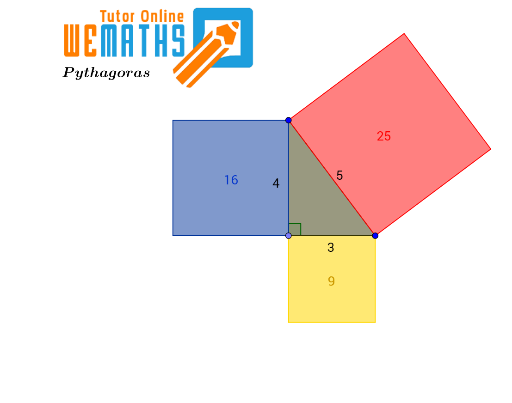
① This interactive GeoGebra example dynamically demonstrates the Pythagorean theorem by showing the relationship among the areas of three squares constructed on the sides of a right triangle: the sum of the areas on the two legs equals the area on the hypotenuse. ② The core mathematical concept is the Pythagorean theorem (or Pythagoras' theorem) and the geometric verification through area comparison. ③ Construction details: The applet uses GeoGebra commands such as Semicircle, Point, Polygon, OrthogonalLine, Circle, Intersect, Angle, PointIn, and Distance to build a right triangle and squares on each side. Users can drag the blue point to change the triangle's shape and observe real-time updates of the square areas. ④ This resource is suitable for Grade 8 students (ม.2) learning the Pythagorean theorem as an exploratory activity, and for teachers to use in classroom demonstrations to help students grasp the geometric meaning of the theorem through area relationships.
GeoGebra Commands & Parameters
Semicircle(A, B) → cPoint(c) → CPolygon(A, C, B) → poly1, b, a, c_1OrthogonalLine(B, c_1) → fOrthogonalLine(A, c_1) → gOrthogonalLine(B, a) → hOrthogonalLine(C, a) → iOrthogonalLine(C, b) → jOrthogonalLine(A, b) → kCircle(B, A) → dCircle(C, B) → eCircle(C, A) → pIntersect(d, f) → D, EOrthogonalLine(E, f) → lIntersect(l, g) → FIntersect(e, i) → G, HOrthogonalLine(H, i) → mIntersect(h, m) → IIntersect(p, j) → J, KOrthogonalLine(K, j) → nIntersect(k, n) → LPolygon(B, E, F, A) → poly2, b_1, e_1, f_1, a_1Polygon(I, B, C, H) → poly3, i_1, b_2, c_2, h_1Polygon(C, K, L, A) → poly4, c_3, k_1, l_1, a_2Angle(A, C, B) → αPointIn(poly2) → Pointpoly2PointIn(poly3) → Pointpoly3PointIn(poly4) → Pointpoly4Distance(C, A) → distanceCADistance(B, A) → distanceBADistance(C, B) → distanceCB