
Geometric Transformations and Properties of Similar Triangles
Loading the math board and drawing, please wait…
In collections
Homothety, Rotation Symmetry -RO
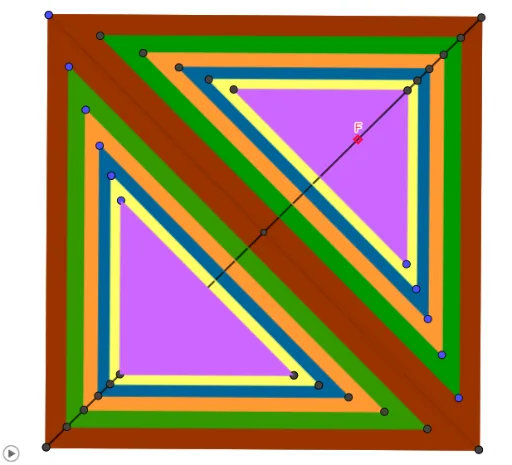
This GeoGebra example demonstrates a series of similar triangles formed through geometric transformations (dilatation and mirroring), illustrating the fundamental properties of similar triangles. The core mathematical concepts include similar triangle recognition, similarity transformation (Dilate), and reflection (Mirror). Construction details: Based on the construction summary, the example uses the Polygon command to create triangle ABC, applies the Dilate command to produce D', B', C' through similarity transformation, uses the Mirror command to generate D'', B'', C'' via axial symmetry, and can iteratively perform multiple transformations to create a progressive sequence of similar triangles. Commands like Segment, Midpoint, and Point are also used for precise geometric construction. This example is suitable for middle school mathematics teaching on similarity, demonstrating the relationship between similar triangles and transformations, helping students understand invariance and variation in similarity transformations, and serving as a model for geometric construction practice.
GeoGebra Commands & Parameters
Polygon(A, B, 4) → poly1, f, g, h, i, C, DSegment(C, A) → jMidpoint(j) → ESegment(D, B) → kPolygon(D, B, C) → t1, c, d, bPoint(j) → FDilate(D, 5 / 6, F) → D'Dilate(B, 5 / 6, F) → B'Dilate(C, 5 / 6, F) → C'Polygon(D', B', C') → t1', c', d', b'Dilate(D', 5 / 6, F) → D''Dilate(B', 5 / 6, F) → B''Dilate(C', 5 / 6, F) → C''Polygon(D'', B'', C'') → t1'', c'', d'', b''Dilate(D'', 5 / 6, F) → D'''Dilate(B'', 5 / 6, F) → B'''Dilate(C'', 5 / 6, F) → C'''Polygon(D''', B''', C''') → t1''', c''', d''', b'''Dilate(D''', 5 / 6, F) → GDilate(B''', 5 / 6, F) → HDilate(C''', 5 / 6, F) → IPolygon(G, H, I) → t2, i_1, g_1, h_1Dilate(G, 5 / 6, F) → G'Dilate(H, 5 / 6, F) → H'Dilate(I, 5 / 6, F) → I'Polygon(G', H', I') → t2', i', g', h'Mirror(D, E) → D'_1Mirror(B, E) → B'_1Mirror(C, E) → C'_1Polygon(D'_1, B'_1, C'_1) → t1'_1, c'_1, d'_1, b'_1Mirror(D', E) → D''_1Mirror(B', E) → B''_1Mirror(C', E) → C''_1Polygon(D''_1, B''_1, C''_1) → t1''_1, c''_1, d''_1, b''_1Mirror(D'', E) → D'''_1Mirror(B'', E) → B'''_1Mirror(C'', E) → C'''_1Polygon(D'''_1, B'''_1, C'''_1) → t1'''_1, c'''_1, d'''_1, b'''_1Mirror(D''', E) → JMirror(B''', E) → KMirror(C''', E) → LPolygon(J, K, L) → t3, l, j_1, k_1Mirror(G', E) → G''Mirror(H', E) → H''Mirror(I', E) → I''Polygon(G'', H'', I'') → t2'', i'', g'', h''Mirror(G', E) → G''_1Mirror(G, E) → G'_1Mirror(H, E) → H'_1Mirror(G, E) → G'_2Mirror(H, E) → H'_2Mirror(I, E) → I'_1Polygon(G'_2, H'_2, I'_1) → t2'_1, i'_1, g'_2, h'_2
AI Drawing Prompt Reference
Draw a figure consisting of multiple similar triangles. Start with triangle ABC. Apply a dilation to obtain triangle D'B'C'. Then reflect to get triangle D''B''C''. Continue with further dilations and reflections to generate additional similar triangles. Show the similarity relationships and transformation steps.
The prompt above was compiled from the original drawing commands and is for reference only.