
Geometric Representation of Complex Roots by Juan Carlos Ponce Campuzano
Loading the math board and drawing, please wait…
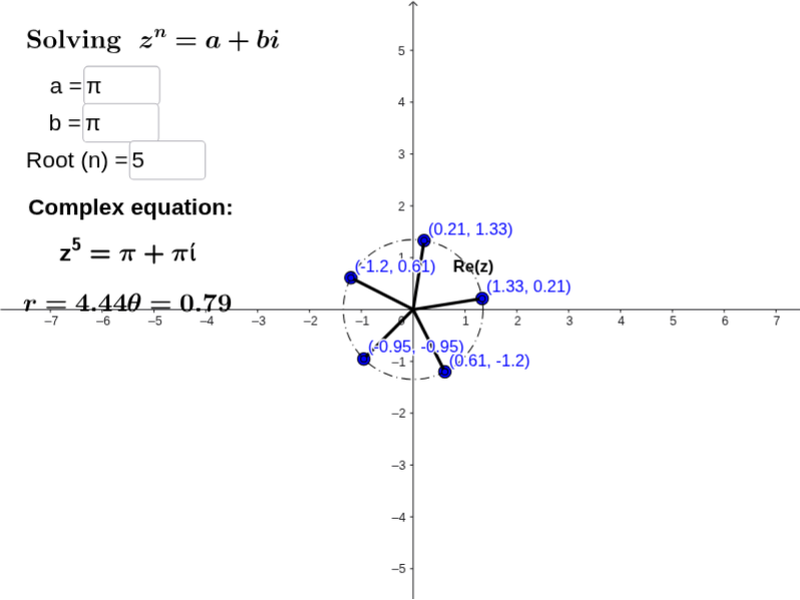
This example demonstrates the geometric representation of the roots of a complex number in the complex plane. Key math concepts include complex numbers, roots, trigonometric functions, and geometric construction. It utilizes GeoGebra commands and objects such as Point, Angle, Sequence, Textfield, Max, Element, and Circle. Suitable for high school mathematics education and complex number learning.
GeoGebra Commands & Parameters
Point(v) → CPoint(xAxis) → BAngle(B, C, A) → αSequence((r^(1 / n) * cos((α + ((2 * π) * i)) / n)), i, 0, n - 1, 1) → list3, {1.330922910810629, 0.21079748034384427, -1.2006429032152952, -0.9528356028822473, 0.6117581149430692}Sequence((r^(1 / n) * sin((α + ((2 * π) * i)) / n)), i, 0, n - 1, 1) → list4, {0.2107974803438442, 1.330922910810629, 0.6117581149430694, -0.9528356028822471, -1.2006429032152957}Sequence(((r^(1 / n) * cos((α + ((2 * π) * i)) / n)), (r^(1 / n) * sin((α + ((2 * π) * i)) / n))), i, 0, n - 1, 1) → list1, {(1.330922910810629, 0.2107974803438442), (0.21079748034384427, 1.330922910810629), (-1.2006429032152952, 0.6117581149430694), (-0.9528356028822473, -0.9528356028822471), (0.6117581149430692, -1.2006429032152957)}Sequence(Segment[(0, 0), ((r^(1 / n) * cos((α + ((2 * π) * i)) / n)), (r^(1 / n) * sin((α + ((2 * π) * i)) / n)))], i, 0, n - 1, 1) → list2, {1.3475130323080184, 1.3475130323080184, 1.3475130323080182, 1.3475130323080187, 1.3475130323080187}Textfield(a) → inputBox1Textfield(b) → inputBox2Textfield(n) → inputBox3Max(list6) → cMax(list5) → dElement(list1, A1) → B1Element(list1, A2) → B2Element(list1, A3) → B3Element(list1, A4) → B4Element(list1, A5) → B5Element(list1, A6) → B6Element(list1, A7) → B7Element(list1, A8) → B8Element(list1, A9) → B9Element(list1, A10) → B10Element(list1, A11) → B11Element(list1, A12) → B12Element(list1, A13) → B13Element(list1, A14) → B14Element(list1, A15) → B15Element(list1, A16) → B16Element(list1, A17) → B17Element(list1, A18) → B18Element(list1, A19) → B19Element(list1, A20) → B20Element(list1, A21) → B21Element(list1, A22) → B22Element(list1, A23) → B23Element(list1, A24) → B24Element(list1, A25) → B25Element(list1, A26) → B26Element(list1, A27) → B27Element(list1, A28) → B28Element(list1, A29) → B29Element(list1, A30) → B30Element(list1, A31) → B31Element(list1, A32) → B32Element(list1, A33) → B33Element(list1, A34) → B34Element(list1, A35) → B35Element(list1, A36) → B36Element(list1, A37) → B37Element(list1, A38) → B38Element(list1, A39) → B39Element(list1, A40) → B40Element(list1, A41) → B41Element(list1, A42) → B42Element(list1, A43) → B43Element(list1, A44) → B44Element(list1, A45) → B45Element(list1, A46) → B46Element(list1, A47) → B47Element(list1, A48) → B48Element(list1, A49) → B49Element(list1, A50) → B50Element(list1, A51) → B51Circle(C, r^(1 / n)) → eMax(c, d) → f
AI Drawing Prompt Reference
Draw a geometric representation of the n-th roots of a complex number in the complex plane. The figure includes the origin, a point B on the x-axis, angle α, and n points representing the roots (line segments from the origin). Also add text boxes for input parameters. The construction order is: define points C and B, define angle α; generate the coordinates of the roots; draw line segments from the origin to these points; finally add the text boxes.
The prompt above was compiled from the original drawing commands and is for reference only.