
Geometric Construction of Cyclic Shapes
Loading the math board and drawing, please wait…
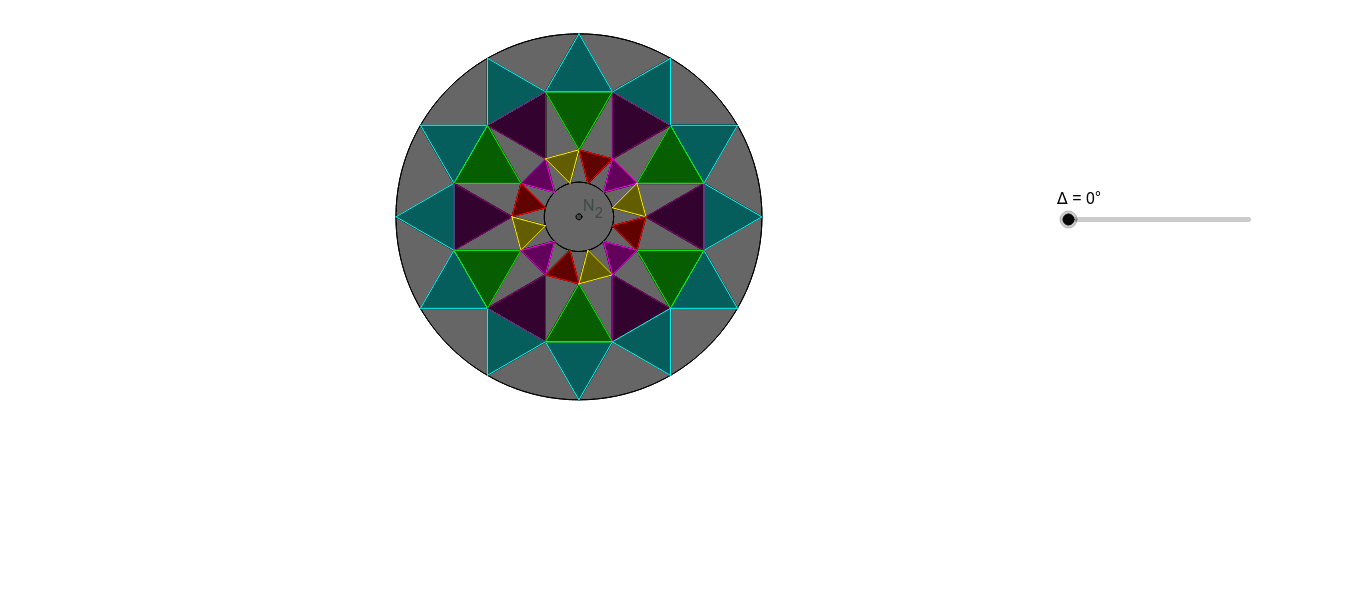
This example demonstrates the geometric construction of cyclic shapes. It involves core mathematical concepts such as ellipses, sine functions, and random experiments. Using GeoGebra commands like Polygon, Circle, and Intersect, specific geometric shapes with certain properties can be constructed. Suitable for high school mathematics education and learning, particularly for coordinate geometry and trigonometry.
GeoGebra Commands & Parameters
Polygon(A, B, 12) → poly1, a, j, k, l, C, D, E, F, G, H, I, b, J, K, L, c, d, e, f, g, h, iPolygon(I, H, 3) → poly2, m, n, p, MPolygon(H, G, 3) → poly3, q, r, s, NPolygon(G, F, 3) → poly4, t, a_1, b_1, OPolygon(F, E, 3) → poly5, c_1, d_1, e_1, PPolygon(E, D, 3) → poly6, f_1, g_1, h_1, QPolygon(D, C, 3) → poly7, i_1, j_1, k_1, RPolygon(C, B, 3) → poly8, l_1, m_1, n_1, SPolygon(B, A, 3) → poly9, p_1, q_1, r_1, TPolygon(A, L, 3) → poly10, s_1, t_1, a_2, UPolygon(L, K, 3) → poly11, b_2, c_2, d_2, VPolygon(K, J, 3) → poly12, e_2, f_2, g_2, WPolygon(J, I, 3) → poly13, h_2, i_2, j_2, ZCircle(W, Z, M) → k_2Circle(J, I, D) → p_2Polygon(H, I, 3) → poly14, l_2, m_2, n_2, A_1Polygon(I, J, 3) → poly15, q_2, r_2, s_2, B_1Polygon(J, K, 3) → poly16, t_2, a_3, b_3, C_1Polygon(K, L, 3) → poly17, c_3, d_3, e_3, D_1Polygon(L, A, 3) → poly18, f_3, g_3, h_3, E_1Polygon(A, B, 3) → poly19, i_3, j_3, k_3, F_1Polygon(B, C, 3) → poly20, l_3, m_3, n_3, G_1Polygon(C, D, 3) → poly21, p_3, q_3, r_3, H_1Polygon(D, E, 3) → poly22, s_3, t_3, a_4, I_1Polygon(E, F, 3) → poly23, b_4, c_4, d_4, J_1Polygon(F, G, 3) → poly24, e_4, f_4, g_4, K_1Polygon(G, H, 3) → poly25, h_4, i_4, j_4, L_1Circle(B_1, A_1, H_1) → k_4Polygon(A_1, B_1, 3) → poly26, l_4, m_4, n_4, M_1Polygon(B_1, C_1, 3) → poly27, p_4, q_4, r_4, N_1Polygon(C_1, D_1, 3) → poly28, s_4, t_4, a_5, O_1Polygon(D_1, E_1, 3) → poly29, b_5, c_5, d_5, P_1Polygon(E_1, F_1, 3) → poly30, e_5, f_5, g_5, Q_1Polygon(F_1, G_1, 3) → poly31, h_5, i_5, j_5, R_1Polygon(L_1, A_1, 3) → poly32, k_5, l_5, m_5, S_1Polygon(K_1, L_1, 3) → poly33, n_5, p_5, q_5, T_1Polygon(J_1, K_1, 3) → poly34, r_5, s_5, t_5, U_1Polygon(I_1, J_1, 3) → poly35, a_6, b_6, c_6, V_1Polygon(H_1, I_1, 3) → poly36, d_6, e_6, f_6, W_1Polygon(G_1, H_1, 3) → poly37, g_6, h_6, i_6, Z_1Polygon(P_1, Q_1, 3) → poly38, j_6, k_6, l_6, A_2Polygon(Q_1, R_1, 3) → poly39, m_6, n_6, p_6, B_2Polygon(O_1, P_1, 3) → poly40, q_6, r_6, s_6, C_2Polygon(N_1, O_1, 3) → poly41, t_6, a_7, b_7, D_2Polygon(C, B, 3) → poly42, c_7, d_7, e_7, E_2Intersect(b, c) → F_2Intersect(q_4, r_4) → K_2Intersect(p_5, q_5) → L_2Intersect(h_6, i_6) → M_2Circle(K_2, L_2, M_2) → f_7Center(f_7) → N_2Rotate(poly2, Δ, N_2) → poly2'Rotate(poly3, Δ, N_2) → poly3'Rotate(poly4, Δ, N_2) → poly4'Rotate(poly5, Δ, N_2) → poly5'Rotate(poly6, Δ, N_2) → poly6'Rotate(poly7, Δ, N_2) → poly7'Rotate(poly9, Δ, N_2) → poly9'Rotate(poly10, Δ, N_2) → poly10'Rotate(poly11, Δ, N_2) → poly11'Rotate(poly12, Δ, N_2) → poly12'Rotate(poly13, Δ, N_2) → poly13'Rotate(poly14, Δ, N_2) → poly14'Rotate(poly15, Δ, N_2) → poly15'Rotate(poly16, Δ, N_2) → poly16'Rotate(poly17, Δ, N_2) → poly17'Rotate(poly18, Δ, N_2) → poly18'Rotate(poly19, Δ, N_2) → poly19'Rotate(poly20, Δ, N_2) → poly20'Rotate(poly21, Δ, N_2) → poly21'Rotate(poly22, Δ, N_2) → poly22'Rotate(poly23, Δ, N_2) → poly23'Rotate(poly24, Δ, N_2) → poly24'Rotate(poly25, Δ, N_2) → poly25'Rotate(poly26, Δ, N_2) → poly26'Rotate(poly27, Δ, N_2) → poly27'Rotate(poly28, Δ, N_2) → poly28'Rotate(poly29, Δ, N_2) → poly29'Rotate(poly30, Δ, N_2) → poly30'Rotate(poly31, Δ, N_2) → poly31'Rotate(poly32, Δ, N_2) → poly32'Rotate(poly33, Δ, N_2) → poly33'Rotate(poly34, Δ, N_2) → poly34'Rotate(poly35, Δ, N_2) → poly35'Rotate(poly36, Δ, N_2) → poly36'Rotate(poly37, Δ, N_2) → poly37'Rotate(poly42, Δ, N_2) → poly42'Rotate(k_2, Δ, N_2) → g_7Rotate(f_7, Δ, N_2) → h_7