
Geometric Construction of Complementary Angles (90°)
Loading the math board and drawing, please wait…
In collections
geometriadinamica.es
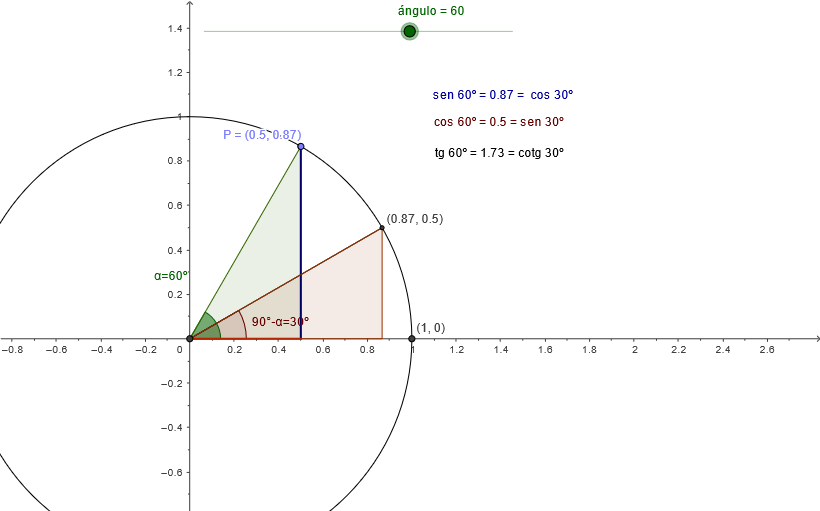
This example demonstrates how to construct and visualize complementary angles—two angles whose sum is 90°—and how their geometric positions correspond under transformations. The main mathematical ideas include angle measurement, the criterion for complementary (co-right) angles, and supporting trigonometric interpretation (e.g., quantities related to sin and cos) through geometric visualization. Construction-wise, it uses GeoGebra commands such as Circle to create reference circles, Intersect to compute intersection points, Rotate and Mirror to obtain complementary configurations via rotational and reflective transformations, Segment and Polygon to build and connect the necessary geometric structures, and Angle to measure and label the resulting angle values. The scene is organized around multiple points and angle objects (e.g., α, β and corresponding transformed points), enabling students to observe and verify the 90° relationship dynamically. Suitable for middle school geometry/trigonometry and for classroom demonstrations or exploratory learning.
GeoGebra Commands & Parameters
Circle((0, 0), 1) → cIntersect(c, xAxis, 2) → AIntersect(xAxis, yAxis) → ORotate(A, (ángulo * pi / 180), O) → PSegment(P, O) → bSegment(P, (x(P), 0)) → senSegment((x(P), 0), O) → cosPolygon(P, O, (x(P), 0)) → Q, a, d, eAngle(P, O, A) → βSegment(P', O) → fAngle(A, O, P') → αMirror(P, xAxis) → P'_1Mirror((x(P), 0), xAxis) → BPolygon(P', O, (y(P), 0)) → Q', g, h, i
AI Drawing Prompt Reference
Draw a geometric figure with a circle, coordinate axes, and points. The circle has its center at the origin and radius 1. It intersects the x-axis at point A and the y-axis at point O. Point A is rotated around point O to get point P. Connect points P, O, and A to form segments b, sen, and cos. Connect point P to the point on the x-axis at (x(P),0) to form segment sen. Connect point P to the origin O to form segment cos. Form a polygon with points P, O, and (x(P),0) to get Q, a, d, e. Measure the angle β between points P, O, and A. Connect point P' to the origin O to form segment f. Measure the angle α between points A, O, and P'. Mirror point P across the x-axis to get P'1, and mirror the point (x(P),0) across the x-axis to get B. Form a polygon with points P', O, and (y(P),0) to get Q', g, h, i. The figure should show the relationship between angles α and β, and the effects of rotation and reflection transformations.
The prompt above was compiled from the original drawing commands and is for reference only.