
Geometric Construction Exercises: Polygons, Angle Bisectors, and Distance Measur
Loading the math board and drawing, please wait…
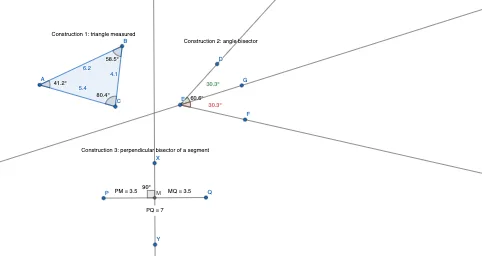
This GeoGebra example demonstrates how to build a structured configuration starting from a polygon and angle-bisector constructions. By varying a parameter, it produces key points and intersection-based geometry that can then be quantified using distance measures. The main math concepts include polygon geometry, defining and working with angles, constructing angle bisectors, finding intersections of constructed lines/rays, and using midpoint and distance to express relationships between points. Construction highlights from the provided summary: Polygon, Angle, Ray, AngularBisector, Point, Segment, LineBisector, Intersect, Distance, and Midpoint are used to create the objects; Text elements are used to label and report computed distances (e.g., distance between pairs of points). The example is well-suited for middle/high-school geometry lessons, GeoGebra instruction on constructions, and early competition-style practice involving angle bisectors and measurement-based reasoning.
GeoGebra Commands & Parameters
Polygon(A, B, C) → t1, c, a, bAngle(C, A, B) → αAngle(A, B, C) → βAngle(B, C, A) → γRay(X, E) → fRay(X, F) → gAngle(E, X, F) → δAngularBisector(E, X, F) → hPoint(h) → GAngle(E, X, G) → εAngle(F, X, G) → ζSegment(P, Q) → iLineBisector(i) → jPoint(j) → DPoint(j) → YIntersect(j, i) → MAngle(P, M, D) → ηDistance(P, Q) → distancePQMidpoint(P, Q) →Distance(P, M) → distancePMMidpoint(P, M) →Distance(M, Q) → distanceMQMidpoint(M, Q) →
AI Drawing Prompt Reference
Draw a triangle ABC, then draw the angle bisectors and find their intersections with the sides at points G, H, and I. Next, draw the perpendicular bisector of line segment PQ and find its intersection with PQ at points D and M. Measure and label the distances between points P and Q, P and M, and M and Q.
The prompt above was compiled from the original drawing commands and is for reference only.