
Geometric Construction and Properties of Quadrilateral E
Loading the math board and drawing, please wait…
In collections
Is it a Parallelogram?
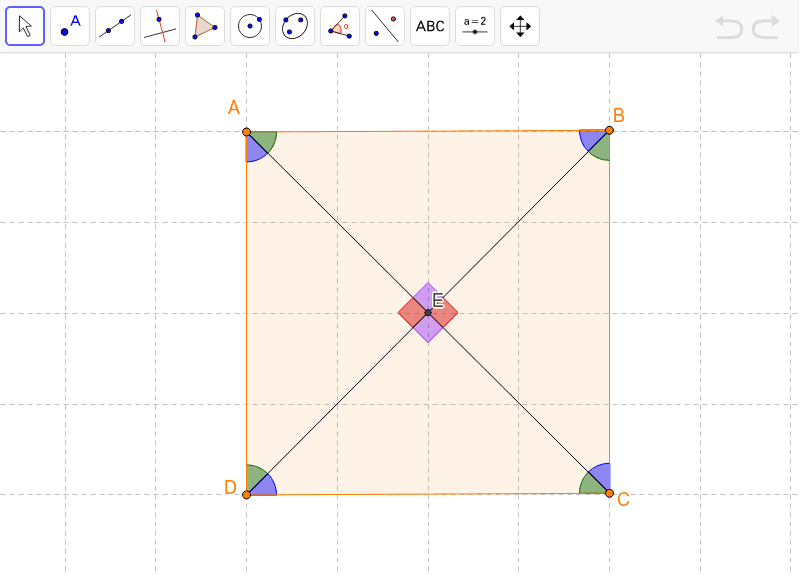
This example demonstrates the geometric construction of Quadrilateral E and its internal angle relationships. Core mathematical concepts include polygon properties, angle measurement, line intersections, and geometric transformations. Construction relies on GeoGebra commands such as Point, Segment, Line, Intersect, Polygon, and Angle. Suitable for middle school geometry students or math teachers for classroom demonstration and lesson planning to understand figure structures.
GeoGebra Commands & Parameters
Point(Circle[A, 8]) → BSegment(A, B) → aPoint(Circle[B, 8]) → CSegment(B, C) → bLine(C, a) → cLine(A, b) → dIntersect(c, d) → DPolygon(A, D, C, B) → poly1, a_1, d_1, c_1, b_1Segment(A, C) → eSegment(D, B) → fIntersect(e, f) → EAngle(E, A, B) → αAngle(E, B, C) → βAngle(E, C, D) → γAngle(E, D, A) → δAngle(D, A, E) → εAngle(A, B, E) → ζAngle(B, C, E) → ηAngle(C, E, B) → θAngle(A, E, D) → ιAngle(D, E, C) → κAngle(B, E, A) → λAngle(C, D, E) → μ
AI Drawing Prompt Reference
Draw a quadrilateral whose four vertices are determined by two equal-radius circles and their intersections. Start with two circles of equal radius, with centers at two adjacent vertices. Pick a point on the second circle as the third vertex. Then draw a line through the third vertex parallel to the first side, and a line through the first vertex parallel to the second side; their intersection gives the fourth vertex. Connect the four vertices to form the quadrilateral, and draw both diagonals; their intersection is an interior point. Finally, measure multiple angles involving this intersection point and the vertices, including the four angles at the intersection, angles between the intersection and adjacent vertices, and angles within the triangles formed, to illustrate the angle relationships.
The prompt above was compiled from the original drawing commands and is for reference only.