
Geometric Construction and Focal Properties of an Ellipse
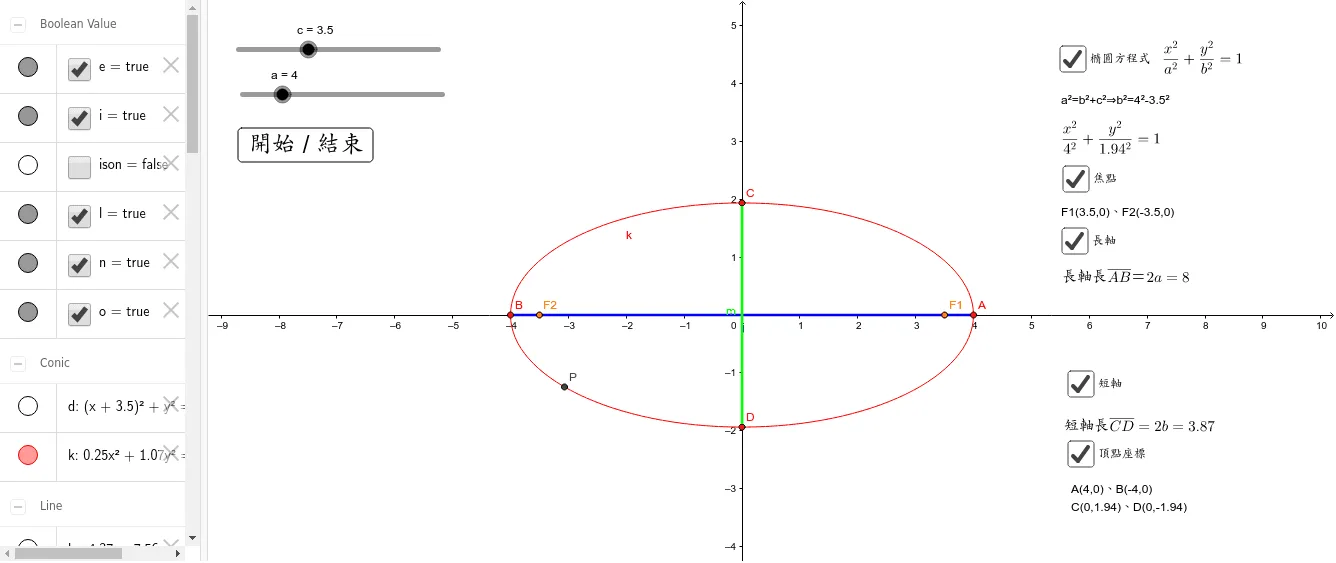
This GeoGebra example demonstrates the classical geometric construction of an ellipse. Using two foci F1 and F2, the applet employs circles, segments, perpendicular bisectors, and intersection points to dynamically illustrate the defining property that the sum of distances from any point on the ellipse to the two foci remains constant. The construction involves drawing auxiliary circles, computing perpendicular bisectors of segments connecting points on the auxiliary circle to one focus, and finding intersection points with specific lines to locate points lying on the ellipse. Users can interact with the applet by dragging foci, adjusting the auxiliary circle radius, and observing how the traced locus consistently satisfies the focal distance property. The visualization makes it clear that every constructed point on the curve maintains an equal total distance to F1 and F2, reinforcing the fundamental geometric definition of an ellipse as the locus of points whose distances to two fixed foci sum to a constant value. This interactive demonstration is particularly valuable for students studying analytic geometry and conic sections, as it bridges the gap between the abstract algebraic definition of an ellipse and its concrete geometric origins. By actively manipulating the construction elements, learners gain intuitive insight into how ellipses are formed, why their shape depends on the positions of the foci and the chosen constant sum, and how perpendicular bisector techniques serve as a powerful tool for generating conic curves. The applet supports classroom instruction by providing a dynamic, visual proof of ellipse construction that complements formal lessons on conic sections and locus problems.
Loading the math board and drawing, please wait…