
GeoGebra Lesson: Reflecting Functions
Loading the math board and drawing, please wait…
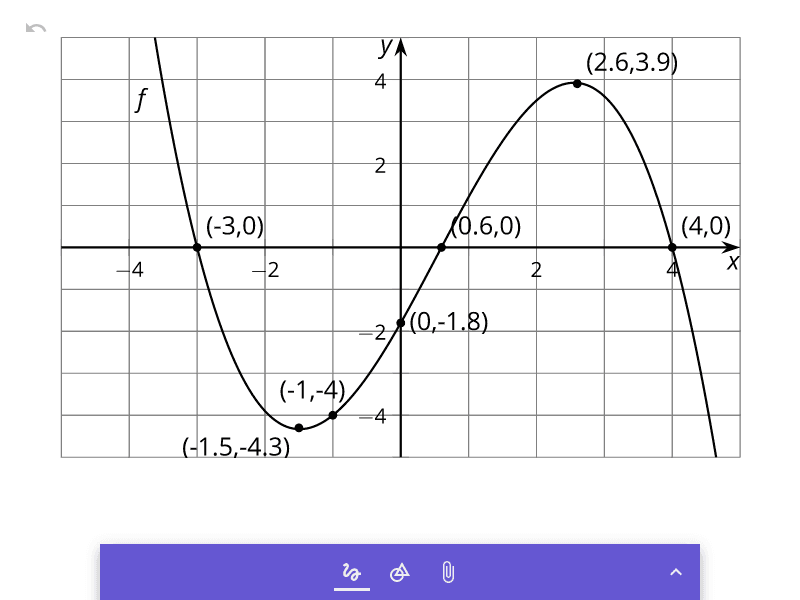
This example demonstrates how to mirror a function’s graph across a chosen line of symmetry (commonly the y-axis or another horizontal/vertical axis) to obtain the reflected function and to visualize the geometric correspondence between original and transformed points. The key ideas are function symmetry, graph transformations (reflection), coordinate mapping rules, and how mirrored points preserve distances to the mirror line while reversing the appropriate coordinate component. In practice, the construction starts by plotting the original function and defining the reflection axis, then generating the reflected graph by applying the corresponding coordinate transformation or using GeoGebra’s reflection/symmetry operations on points/objects. It typically involves creating the function graph and the mirror line, producing reflected points or curves, and verifying symmetry by highlighting corresponding pairs and their equal perpendicular distances to the axis. Suitable for middle and high school instruction on function graphs and transformations, as well as interactive classroom demonstrations and student exploration.
AI Drawing Prompt Reference
Draw a function graph and reflect it across a line of symmetry. Key objects include the original function curve, the symmetry axis, and the reflected curve. The construction order is to first draw the original function, then define the symmetry axis, then generate the reflected curve using reflection operations, and finally verify symmetry.
The prompt above was compiled from the original drawing commands and is for reference only.