
Galton Board & Binomial Distribution by Helmholtz - class 10a (2)
Loading the math board and drawing, please wait…
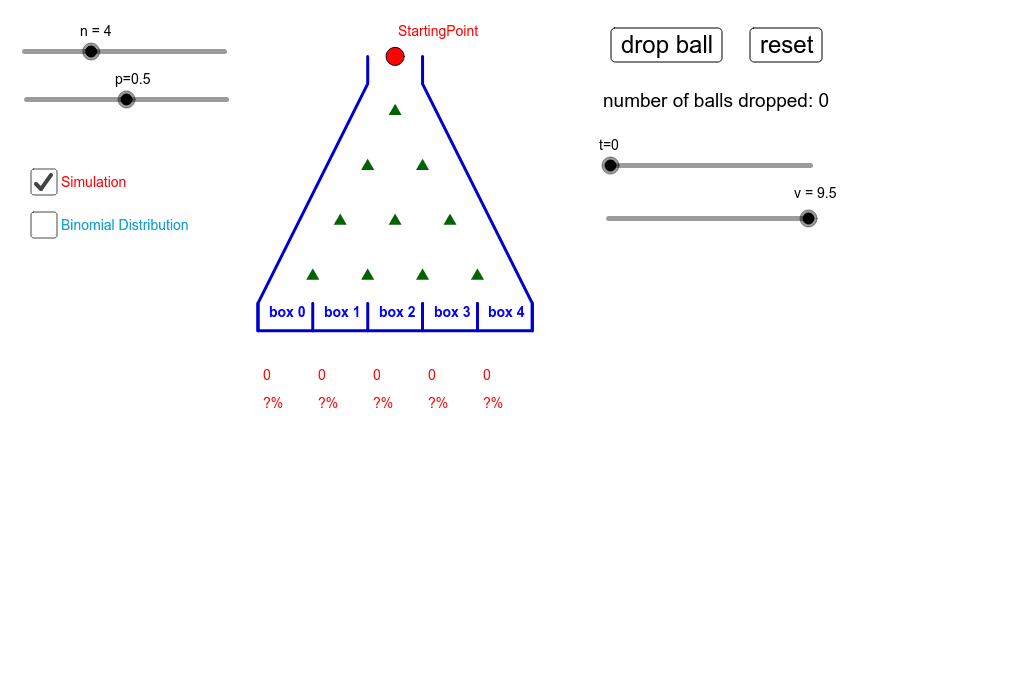
This example demonstrates the relationship between the Galton Board experiment and the Binomial Distribution, visually showing the statistical pattern of random events repeated multiple times. Core mathematical concepts include Binomial Distribution, Probability & Statistics, Linear Programming/Optimization. Construction highlights the use of GeoGebra commands like Sequence, Join, Shuffle, Append, Point, PolyLine, and Sum. Suitable for high school students and math enthusiasts learning probability statistics and discrete mathematics, ideal for teaching demonstrations or algorithm comprehension.
GeoGebra Commands & Parameters
Sequence(Sequence[(i, j), i, j / 2, n - j / 2], j, 1, n) → boardSequence(Polygon[(i - 0.5, 0), (i + 0.5, 0), (i + 0.5, (BinomialDist[n, 1 - p, n - i, false] * h)), (i - 0.5, (BinomialDist[n, 1 - p, n - i, false] * h))], i, 0, n) → BinomialDistJoin({Sequence[-0.5, i, 1, ((10 * n) * (1 - p))], Sequence[0.5, i, 1, ((10 * p) * n)]}) → unshuffleShuffle(unshuffle) → shuffleAppend((n / 2, n + 1), Sequence[(n / 2, n + 1) + (Sum[First[shuffle, i]], (-i)), i, 1, n]) → pathSequence(Segment[(i - 1 / 2, 0), (i - 1 / 2, 1 / 2)], i, 0, n + 1) → containerAppend(Sequence[Segment[Element[path, i - 1], Element[path, i]], i, 1, n + 1], Segment[Element[path, n + 1], Element[path, n + 1] + (0, -1)]) → linePoint(line, t) → PPolyLine(((n - 1) / 2, n + 1), ((n - 1) / 2, n + 0.5), (-0.5, 0.5), (-0.5, 0), (n + 0.5, 0), (n + 0.5, 0.5), ((n - 1) / 2 + 1, n + 0.5), ((n + 1) / 2, n + 1)) → lSequence(Polygon[(i - 1.5, 0), (i - 0.5, 0), (i - 0.5, (Element[rec, i] / Sum[rec] * h)), (i - 1.5, (Element[rec, i] / Sum[rec] * h))], i, 1, n + 1) → box_1Sum(rec) → numberSequence(Text[(Element[BinomialDist, i] / h * 100) + "%", (i - 1.4, -0.4)], i, 1, n + 1) → binopercentSequence(Text[Element[rec, i], (i - 1.4, -0.9)], i, 1, n + 1) → list1Sequence(Text[(Element[rec, i] / number * 100) + "%", (i - 1.4, -1.4)], i, 1, n + 1) → list2Sequence(Text[("box " * i), (i - 0.3, 0.25)], i, 0, n) → boxnumber