
G.GCO.9 Isosceles Triangles: Interactive Discovery of the Converse Theorem
Loading the math board and drawing, please wait…
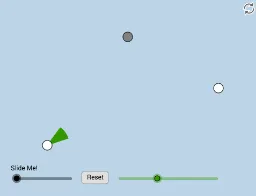
This GeoGebra example provides an interactive discovery environment for the converse of the Isosceles Triangle Theorem: if two angles of a triangle are equal, then the sides opposite those angles are equal. It visually demonstrates the relationship between equal angles and equal sides in a dynamic triangle. Core mathematical concepts include isosceles triangle properties, angle-side correspondence, and logical reasoning in geometry. The construction uses commands such as Rotate to create equal angles, Ray and Intersect to define vertices, Segment and Polygon to form the triangle, and Circle/CircleSector for auxiliary circles. Sliders and buttons allow users to manipulate the figure and observe invariant properties. Additional transformations like Dilate and Translate support exploration of related configurations. This resource is suitable for middle school (grades 8-9) and high school students learning geometric proofs, as well as for teachers demonstrating theorem discovery in a dynamic geometry setting.
GeoGebra Commands & Parameters
Rotate(B, (-α), A) → B'Angle(B', A, B) → βRay(A, B') → fPoint(f) → CRotate(A, (-α), C) → A'Angle(A', C, A) → γRay(C, A') → gRay(A, B) → hIntersect(g, h) → DSegment(A, D) → iSegment(C, D) → jSegment(A, C) → kPolygon(A, C, D) → poly1, d, a, cMin(i, k) → eCircle(A, (0.2 * e)) → pIntersect(p, k, 1) → EIntersect(p, i, 1) → FCircleSector(A, E, F) → qDilate(A, If[0 < b ≤ 1, 1 - b, 0], C) → A'_1Segment(A, A'_1) → lVector(A, A'_1) → uTranslate(q, u) → q'Rotate(q', If[1 < b ≤ 2, ((b - 1) * (π - α)), π - α], C) → q''Dilate(A, If[2 < b ≤ 3, 3 - b, 0], D) → A'_2Dilate(C, If[2 < b ≤ 3, 3 - b, 0], D) → C'Segment(A, A'_2) → mSegment(C, C') → nRotate(A, If[3.5 < b ≤ 4.5, ((b - 3.5) * (π - (2 * α))), π - (2 * α)], D) → A'_3Rotate(A'_2, If[3.5 < b ≤ 4.5, ((b - 3.5) * (π - (2 * α))), π - (2 * α)], D) → GSegment(A'_3, G) → m'
AI Drawing Prompt Reference
Create a dynamic geometric figure to explore the converse of the isosceles triangle theorem: if two angles are equal, the opposite sides are equal. Start with a ray and a point on it, then use rotation to create equal angles, and find the third vertex by intersecting rays. Connect the vertices to form a triangle. Add auxiliary circles and sectors to highlight the equal angles. Include sliders to control transformations like translation, rotation, and scaling, demonstrating the relationship between angles and side lengths. The figure should have adjustable angles, a triangle, auxiliary circles, and dynamic elements.
The prompt above was compiled from the original drawing commands and is for reference only.