
Fundamental Theorem of Calculus II: Linking the Integral Function to Derivatives
Loading the math board and drawing, please wait…
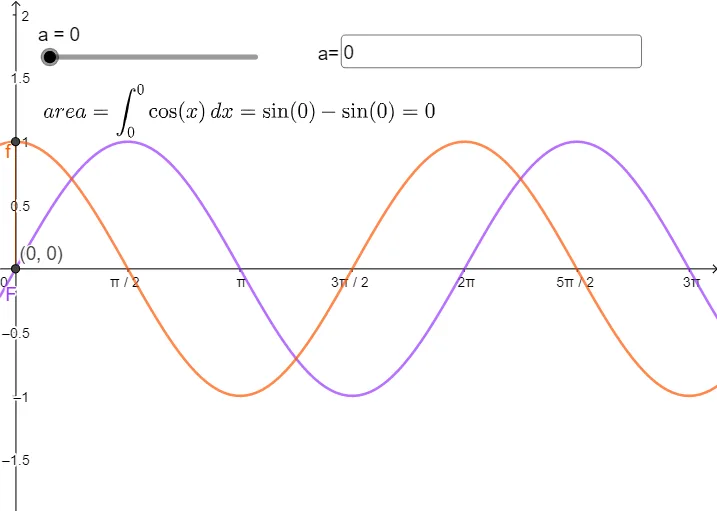
This example demonstrates the key idea of the Fundamental Theorem of Calculus (Part II): the rate of change of an integral function matches the original integrand. It builds an object of the form F(x)=∫_a^x f(t)dt and uses the resulting representation to make the relationship between F'(x) and f(x) visually and conceptually clear. The main concepts include calculus in the form of the Fundamental Theorem of Calculus (Part II), integral functions, definite integrals with a variable upper limit, and the connection to derivatives. The construction follows the GeoGebra commands and objects indicated in the summary: the Integral command to define the integral-based function, Textfield to present formulas/values, and input/output objects such as F, f, a, InputBox1, B, plus area/A and text1 to show the integral’s geometric meaning (area) and label the key quantities. Suitable for advanced high school and first-year college calculus instruction, especially for lessons connecting definite integrals to differentiation.
GeoGebra Commands & Parameters
Integral(f, 0, a) → areaTextfield(a) → InputBox1
AI Drawing Prompt Reference
Draw the indefinite integral F(x) = ∫_0^x f(t)dt of a function f(x), where 0 is the lower limit and x is the upper limit. Observe the changes in F(x) as x varies and show the relationship between F'(x) and f(x). Use a text box to input the value of x and display the geometric meaning of the integral, i.e., the area, in the graph.
The prompt above was compiled from the original drawing commands and is for reference only.