
Fun with GeoGebra Translation and Reflection
Loading the math board and drawing, please wait…
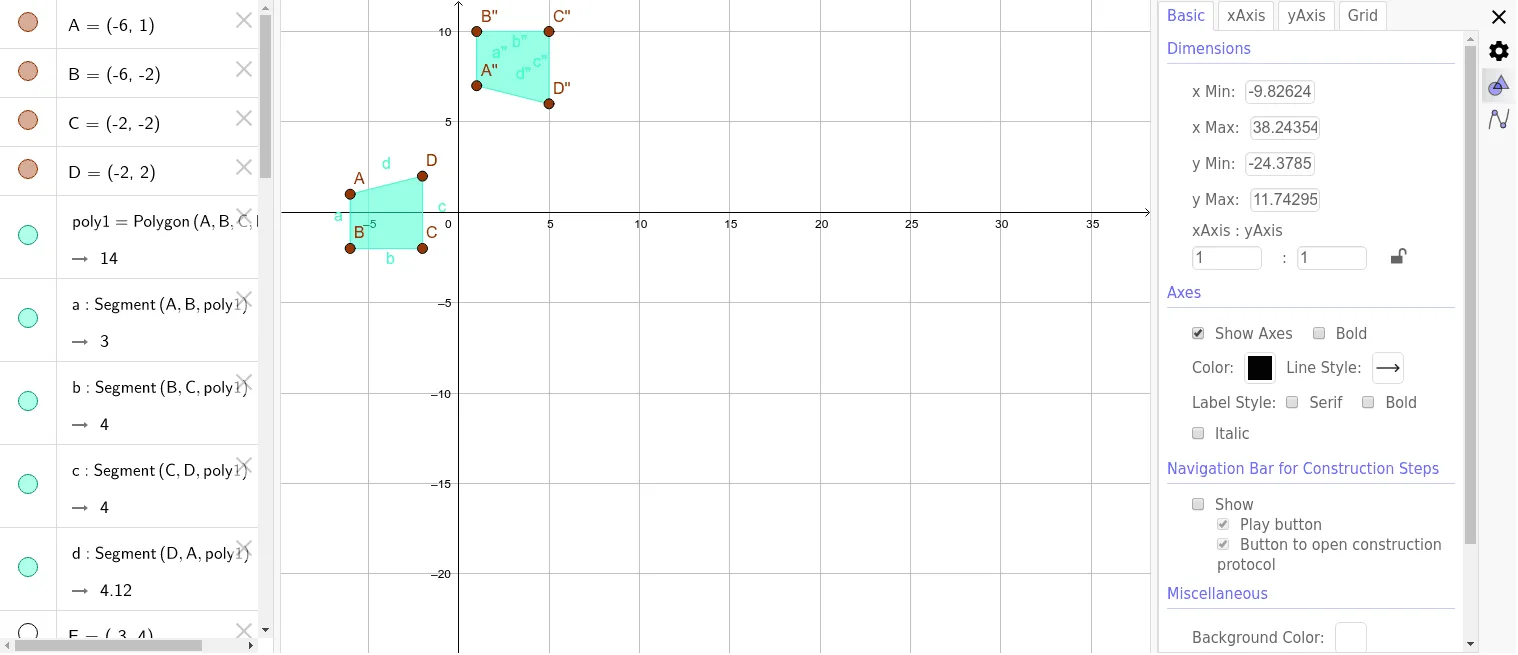
This example demonstrates the use of GeoGebra to perform translations and reflections on polygons, showcasing the application of transformations in geometric figures. Core mathematical concepts include translation, reflection, intersection, fractal geometry, fractions, confidence interval, and rational numbers. The construction involves commands and objects like Polygon, Vector, Translate, and Mirror as outlined in the summary. It is suitable for high school students learning geometric transformations and for math clubs.
GeoGebra Commands & Parameters
Polygon(A, B, C, D) → poly1, a, b, c, dVector(E, F) → uTranslate(A, u) → A'Translate(B, u) → B'Translate(C, u) → C'Translate(D, u) → D'Polygon(A', B', C', D') → poly1', a', b', c', d'Mirror(A', f) → A''Mirror(B', f) → B''Mirror(C', f) → C''Mirror(D', f) → D''Polygon(A'', B'', C'', D'') → poly1'', a'', b'', c'', d''
AI Drawing Prompt Reference
Draw a quadrilateral, then create a vector and translate the quadrilateral using this vector to form a new quadrilateral. Reflect the new quadrilateral over a line to get a second quadrilateral, and reflect the second quadrilateral over the same line to obtain the final shape, showcasing the translation and reflection transformations.
The prompt above was compiled from the original drawing commands and is for reference only.