
Free Fall Motion Simulation on a Sphere
Loading the math board and drawing, please wait…
In collections
The Domain of the Time (intuitive kinematics)
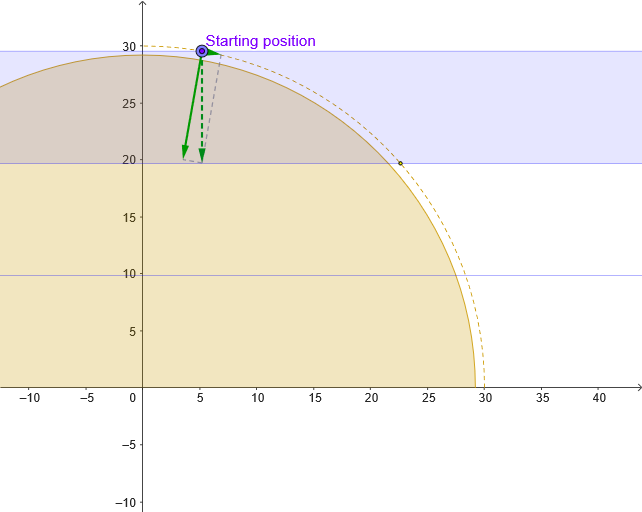
This GeoGebra example simulates an object undergoing free fall motion along a spherical surface. Key mathematical concepts include spherical geometry, parametric equations, velocity and acceleration vectors, and trajectory tracking. Construction highlights: UnitOrthogonalVector and CircleSector are used to draw spherical arcs, Segment constructs displacement vectors, CircleArc and Semicircle create motion paths, Intersect finds trajectory intersections, and animation sliders (anima, t0, t1, dt) enable visual representation of the motion. Ideal for high school physics courses on centripetal motion and gravity decomposition, as well as university-level differential geometry demonstrations of geodesic concepts.
GeoGebra Commands & Parameters
Segment(M, (0, 0)) → rMUnitOrthogonalVector(rM) → nSegment(M + g, M + gt) → sSegment(M + g, M + gn) → s2CircleSector((0, 0), (r, 0), Rotate[(r, 0), 89.99°]) → dPoint(d) → PCircleArc((0, 0), (r, 0), (0, r)) → acPoint(d) → MMIntersect(ac, Ray[(0, (2 * y(P) / 3)), (1, (2 * y(P) / 3))]) → Q,Segment(P, (x(P), y(M))) → hSemicircle(((-r) + rb, 0), (r - rb, 0)) → sc'
AI Drawing Prompt Reference
Draw a free fall motion simulation on a sphere. The graph includes a sphere, an object falling from the sphere's surface, and the object's trajectory on the sphere. The trajectory is made of arcs on the sphere's surface, with the object moving from the start point to the end point. The trajectory intersects the sphere's surface at a point. The motion path consists of arcs and circular arcs, illustrating concepts of gravity decomposition and centripetal force.
The prompt above was compiled from the original drawing commands and is for reference only.