
Free Fall Constant Acceleration and Quadratic Functions
Loading the math board and drawing, please wait…
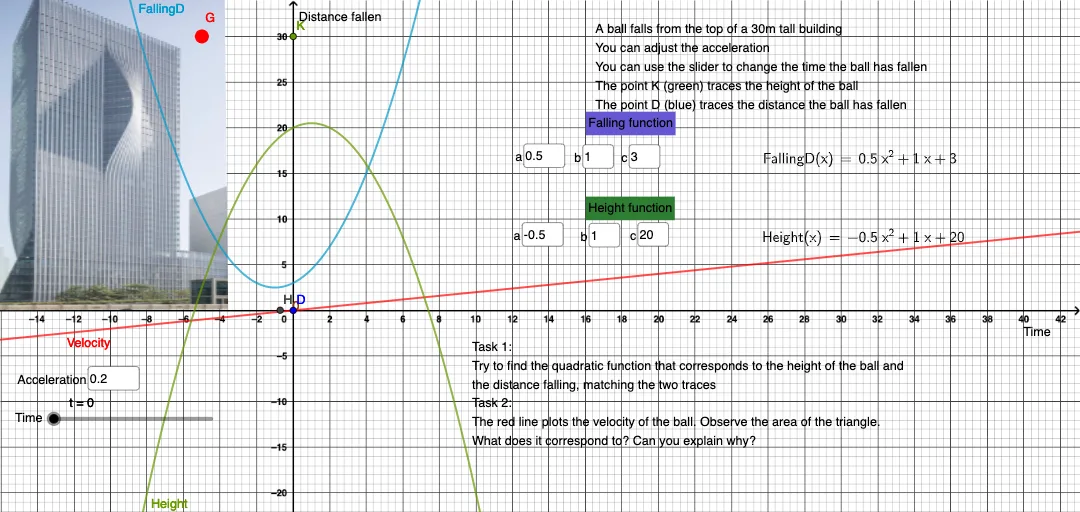
This GeoGebra example demonstrates free fall motion under constant gravitational acceleration, showing the complete parabolic relationship between displacement and time. Core mathematical concepts include quadratic function graphs, vertex and general form conversions, and physics concepts of velocity and acceleration. Construction highlights: InputBox controls for adjusting initial height (h) and acceleration (a), Polygon for drawing the parabolic trajectory, LaTeX displaying displacement formulas s=vt+½at² and t² relationships, Velocity text showing real-time speed values, and Slider animating time parameter (t). Suitable for high school mathematics courses on quadratic functions and physics kinematics visualization, helping students intuitively understand interdisciplinary connections between mathematics and physics.
GeoGebra Commands & Parameters
Polygon(A, B, C) → t1, c, a_1, bTextfield(a) → InputBox1Textfield(aa) → InputBox2Textfield(bb) → InputBox3Textfield(cc) → InputBox4LaTeX(FallingD, true, true) → text7Textfield(aaa) → InputBox5Textfield(bbb) → InputBox6Textfield(ccc) → InputBox7LaTeX(Height, true, true) → text8
AI Drawing Prompt Reference
Draw a graph demonstrating free fall motion with a parabolic trajectory, featuring input boxes for adjusting initial height and acceleration, LaTeX formulas for displacement and t² relationships, real-time velocity display, and an animated slider for time parameter to illustrate the connection between quadratic functions and physics.
The prompt above was compiled from the original drawing commands and is for reference only.