
Fraction Sandbox: Visualizing Fractions with Geometric Construction
Loading the math board and drawing, please wait…
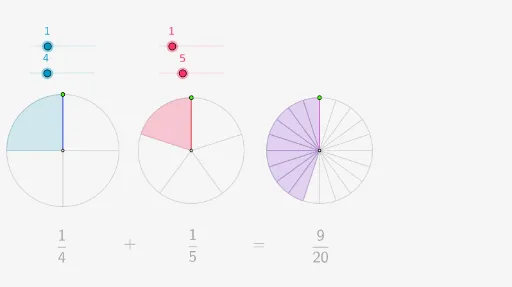
This example, named 'Fraction Sandbox', provides an interactive geometric environment to visualize fractions, their comparisons, and operations. The core mathematical concepts involve fractions, least common multiple (LCM), and the correspondence between fractions and geometric shapes such as circles and segments. The construction uses GeoGebra commands including LCM, Circle, Point, Sequence, and Segment, along with multiple objects like circles (c_1, c_2, c_3, c_4), points (A_1, A_2, A_3, A_4), lists (list1, list2, etc.), and text elements (text3, text5) to dynamically display fraction values. This resource is suitable for upper elementary to middle school students learning fraction concepts, and serves as a teaching aid for demonstrating fraction operations by dragging sliders or points to observe changes, enhancing conceptual understanding.
GeoGebra Commands & Parameters
LCM(d_1, d_2) → d_3Circle(O_1, r_1) → c_1Point(c_1) → A_1Sequence(Sector[c_1, Rotate[A_1, ((2 * π) * i / d_1), O_1], Rotate[A_1, ((2 * π) * (i + 1) / d_1), O_1]], i, 0, d_1 - 1) → list1Sequence(Sector[c_1, Rotate[A_1, ((2 * π) * i / d_1), O_1], Rotate[A_1, ((2 * π) * (i + 1) / d_1), O_1]], i, 0, n_1 - 1) → list2Circle(O_2, r_2) → c_2Point(c_2) → A_2Sequence(Sector[c_2, Rotate[A_2, ((2 * π) * i / d_2), O_2], Rotate[A_2, ((2 * π) * (i + 1) / d_2), O_2]], i, 0, n_2 - 1) → list4Circle(O_3, r_3) → c_3Point(c_3) → A_3Sequence(Sector[c_3, Rotate[A_3, ((2 * π) * i / d_3), O_3], Rotate[A_3, ((2 * π) * (i + 1) / d_3), O_3]], i, 0, p_1 - 1) → list5Sequence(Sector[c_3, Rotate[A_3, ((2 * π) * i / d_3), O_3], Rotate[A_3, ((2 * π) * (i + 1) / d_3), O_3]], i, 0, d_3 - 1) → list6Circle(O_4, r_3) → c_4Point(c_4) → A_4Sequence(Sector[c_4, Rotate[A_4, ((2 * π) * i / d_3), O_4], Rotate[A_4, ((2 * π) * (i + 1) / d_3), O_4]], i, 0, d_3 - 1) → list8Sequence(Sector[c_4, Rotate[A_4, ((2 * π) * i / d_3), O_4], Rotate[A_4, ((2 * π) * (i + 1) / d_3), O_4]], i, 0, p_3 - 1) → list9Sequence(Sector[c_3, Rotate[A_3, ((2 * π) * i / d_3), O_3], Rotate[A_3, ((2 * π) * (i + 1) / d_3), O_3]], i, p_1, Min[n_3 - 1, d_3 - 1]) → list7Sequence(Sector[c_2, Rotate[A_2, ((2 * π) * i / d_2), O_2], Rotate[A_2, ((2 * π) * (i + 1) / d_2), O_2]], i, 0, d_2 - 1) → list3Circle(O_3, A_3) → cSegment(O_1, A_1) → bSegment(O_2, A_2) → dSegment(O_3, A_3) → eSegment(O_4, A_4) → f