
Fraction Guessing Game
Loading the math board and drawing, please wait…
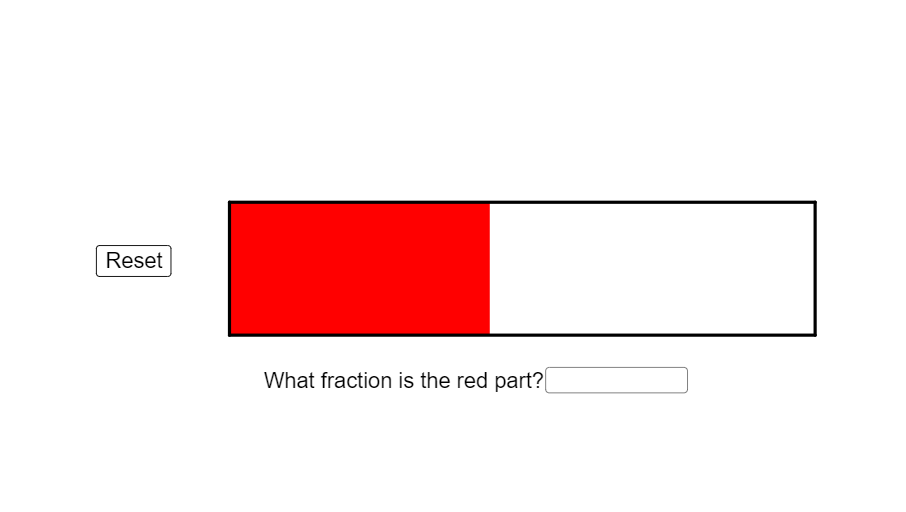
This example randomly generates fractions for students to guess and input the numerator and denominator, practicing the concept of fractions. Key mathematical concepts include fractions, vectors, and points. Using GeoGebra commands such as Random, FractionText, Numerator, and Denominator, the process of generating fractions is dynamically demonstrated. Suitable for high-grade elementary and junior high school students to better understand and master the related knowledge of fractions.
GeoGebra Commands & Parameters
Random(2, 12) → DIf(D ≟ 2, 1, If[D ≟ 3, RandomElement[{1, 2}], If[D ≟ 4, RandomElement[{1, 3}], If[D ≟ 5, RandomElement[{1, 2, 3, 4}], If[D ≟ 6, RandomElement[{1, 5}], If[D ≟ 7, RandomElement[{1, 2, 3, 4, 5, 6}], If[D ≟ 8, RandomElement[{1, 3, 5, 7}], If[D ≟ 9, RandomElement[{1, 2, 4, 5, 7, 8}], If[D ≟ 10, RandomElement[{1, 3, 7, 9}], If[D ≟ 11, RandomElement[{1, 2, 3, 4, 5, 6, 7, 8, 9, 10}], If[D ≟ 12, RandomElement[{1, 5, 7, 11}]]]]]]]]]]]) → NFractionText(N / D) → fracNumerator(N / D) → realNDenominator(N / D) → readDPoint(xAxis) → BPoint(yAxis) → EPolygon(A, B, C, E) → poly1, a, b, c, ePolygon((0, 0), (N / D, 0), (N / D, 1), (0, 1)) → Shaded, d, f_1, g, hPolygon((0, 1.1), (n2, 1.1), (n2, 2.1), (0, 2.1)) → Guess, i, j, k, lSequence(Segment[(i / readD, 0), (i / readD, 1)], i, 1, readD - 1) → barsPolygon((0, 1.1), (1, 1.1), (1, 2.1), (0, 2.1)) → poly2, m, p, q, rIndexOf(47, TextToUnicode[inTxt_2]) → slashTake(inTxt_2, slash + 1) → ODENFromBase(ODEN, 10) → oriddenSequence(Segment[((i * 1 / oridden), 1.1), (i / oridden, 2.1)], i, 1, oridden - 1) → guessbarsTextfield(n) → InputBox1If(Defined[n], oridden) → fIf(Defined[n], oridden) → oIf(Defined[n], oridden) → sIf(Defined[n], oridden) → tIf(Defined[n], oridden) → uIf(Defined[n], oridden) → vIf(Defined[n], oridden) → wIf(Defined[n], oridden) → a_1If(Defined[n], oridden) → b_1If(Defined[n], oridden) → c_1