
Fraction Division Example 1 by lookang
Loading the math board and drawing, please wait…
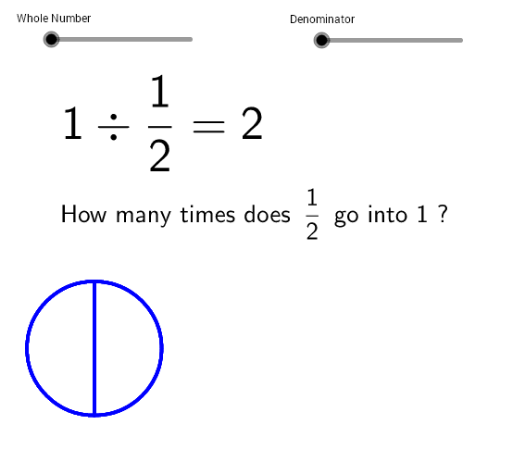
This example demonstrates the concept of fraction division. The core mathematical concepts involved are fraction division operations. Using GeoGebra commands such as Circle, Rotate, Angle, etc., a geometric model of fraction division can be constructed. Suitable for students in middle school and above to learn about fraction division concepts.
GeoGebra Commands & Parameters
Circle(A, 2.5) → cCircle(B, 2.5) → dCircle(C, 2.5) → eRotate(O, (360 / Denominator)°, A) → O'Angle(O, A, O') → αRotate(O', (360 / Denominator)°, A) → O''Angle(O', A, O'') → βRotate(O'', (360 / Denominator)°, A) → O'''Angle(O'', A, O''') → γRotate(O''', (360 / Denominator)°, A) → DAngle(O''', A, D) → δRotate(D, (360 / Denominator)°, A) → D'Angle(D, A, D') → εRotate(D', (360 / Denominator)°, A) → D''Angle(D', A, D'') → ζRotate(D'', (360 / Denominator)°, A) → D'''Angle(D'', A, D''') → ηRotate(D''', (360 / Denominator)°, A) → EAngle(D''', A, E) → θRotate(E, (360 / Denominator)°, A) → E'Angle(E, A, E') → ιRotate(E', (360 / Denominator)°, A) → E''Angle(E', A, E'') → κRotate(F, (360 / Denominator)°, B) → F'Angle(F, B, F') → λRotate(F', (360 / Denominator)°, B) → F''Angle(F', B, F'') → μRotate(F'', (360 / Denominator)°, B) → F'''Angle(F'', B, F''') → νRotate(F''', (360 / Denominator)°, B) → GAngle(F''', B, G) → ξRotate(G, (360 / Denominator)°, B) → G'Angle(G, B, G') → οRotate(G', (360 / Denominator)°, B) → G''Angle(G', B, G'') → ρRotate(G'', (360 / Denominator)°, B) → G'''Angle(G'', B, G''') → σRotate(G''', (360 / Denominator)°, B) → HAngle(G''', B, H) → τRotate(H, (360 / Denominator)°, B) → H'Angle(H, B, H') → υRotate(H', (360 / Denominator)°, B) → H''Angle(H', B, H'') → ϕRotate(I, (360 / Denominator)°, C) → I'Angle(I, C, I') → χRotate(I', (360 / Denominator)°, C) → I''Angle(I', C, I'') → ψRotate(I'', (360 / Denominator)°, C) → I'''Angle(I'', C, I''') → ωRotate(I''', (360 / Denominator)°, C) → JAngle(I''', C, J) → α_1Rotate(J, (360 / Denominator)°, C) → J'Angle(J, C, J') → β_1Rotate(J', (360 / Denominator)°, C) → J''Angle(J', C, J'') → γ_1Rotate(J'', (360 / Denominator)°, C) → J'''Angle(J'', C, J''') → δ_1Rotate(J''', (360 / Denominator)°, C) → KAngle(J''', C, K) → ε_1Rotate(K, (360 / Denominator)°, C) → K'Angle(K, C, K') → ζ_1Rotate(K', (360 / Denominator)°, C) → K''Angle(K', C, K'') → η_1CircleSector(A, O, O') → fCircleSector(A, O', O'') → gCircleSector(A, O'', O''') → hCircleSector(A, O''', D) → kCircleSector(A, D, D') → pCircleSector(A, D', D'') → qCircleSector(A, D'', D''') → rCircleSector(A, D''', E) → sCircleSector(A, E, E') → tCircleSector(A, E', O) → c_1CircleSector(B, F, F') → d_1CircleSector(B, F'', F''') → e_1CircleSector(B, F', F'') → f_1CircleSector(B, F''', G) → g_1CircleSector(B, G, G') → h_1CircleSector(B, G', G'') → k_1CircleSector(B, G'', G''') → p_1CircleSector(B, G''', H) → q_1CircleSector(B, H, H') → r_1CircleSector(B, H', F) → s_1CircleSector(C, I, I') → t_1CircleSector(C, I', I'') → c_2CircleSector(C, I'', I''') → d_2CircleSector(C, I''', J) → e_2CircleSector(C, J, J') → f_2CircleSector(C, J', J'') → g_2CircleSector(C, J'', J''') → h_2CircleSector(C, J''', K) → k_2CircleSector(C, K, K') → p_2CircleSector(C, K', I) → q_2
AI Drawing Prompt Reference
Draw a geometric model for fraction division. Start with three circles of equal radius, each centered at a distinct point. Within each circle, divide the circumference into equal parts based on the denominator, rotating from a starting point by the same angle repeatedly to create multiple division points. Connect each adjacent point to the center to form a series of equal sector angles. The three circles represent the dividend, divisor, and result, and comparing the number and angle of sectors in each circle visually demonstrates the fraction division operation. All circles share the same radius, and the rotation angle is determined by the denominator, resulting in a symmetric and evenly distributed layout.
The prompt above was compiled from the original drawing commands and is for reference only.