
Fraction Division Demonstration by Sébastien Vieilhescazes
Loading the math board and drawing, please wait…
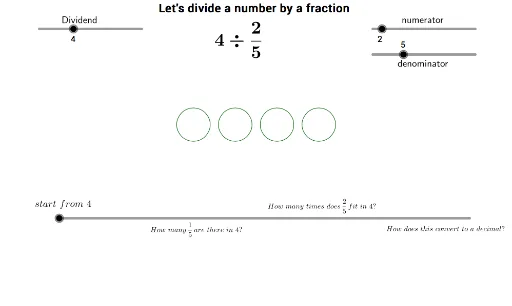
This example dynamically illustrates the calculation and geometric interpretation of fraction division. It involves core math concepts like fraction operations, similar triangles, sequences, and stochastic processes. Key GeoGebra commands and objects used include Sequence, Slider, and Coordinate Geometry for constructing visual models. Suitable for high school mathematics education to understand the intuitive explanation and algebraic derivation of fraction division.
GeoGebra Commands & Parameters
Sequence(CircleSector[C, (x(C) + (r * sin((((i + 1) * 2) * π / d))), y(C) + (r * cos((((i + 1) * 2) * π / d)))), (x(C) + (r * sin(((i * 2) * π / d))), y(C) + (r * cos(((i * 2) * π / d))))], i, 0, c - 1) → list1Sequence(Circle[((((-(a - 1)) * 2.5) * r / 2) + ((k * 2.5) * r), 0), r], k, 0, a - 1) → list2Sequence(Sequence[CircleSector[((((-(a - 1)) * 2.5) * r / 2) + ((k * 2.5) * r), 0), ((((-(a - 1)) * 2.5) * r / 2) + ((k * 2.5) * r) + (r * sin((((i + 1) * 2) * π / d))), (r * cos((((i + 1) * 2) * π / d)))), ((((-(a - 1)) * 2.5) * r / 2) + ((k * 2.5) * r) + (r * sin(((i * 2) * π / d))), (r * cos(((i * 2) * π / d))))], i, 0, d - 1], k, 0, a - 1) → list4Sequence(CircleSector[(cent(f(k)), 0), (cent(f(k)) - (r * sin(((part(f(k)) * 2) * π / d))), (r * cos(((part(f(k)) * 2) * π / d)))), (cent(f(k)) - (r * sin((((part(f(k)) + 1) * 2) * π / d))), (r * cos((((part(f(k)) + 1) * 2) * π / d))))], k, 1, (floor(((a * d) - c) / ((4 * c)) + 1) * c)) → liste1Sequence(CircleSector[(cent(f(k) + c), 0), (cent(f(k) + c) - (r * sin(((part(f(k) + c) * 2) * π / d))), (r * cos(((part(f(k) + c) * 2) * π / d)))), (cent(f(k) + c) - (r * sin((((part(f(k) + c) + 1) * 2) * π / d))), (r * cos((((part(f(k) + c) + 1) * 2) * π / d))))], k, 1, (floor(((a * d) - (2 * c)) / ((4 * c)) + 1) * c)) → liste2Sequence(CircleSector[(cent(f(k) + (2 * c)), 0), (cent(f(k) + (2 * c)) - (r * sin(((part(f(k) + (2 * c)) * 2) * π / d))), (r * cos(((part(f(k) + (2 * c)) * 2) * π / d)))), (cent(f(k) + (2 * c)) - (r * sin((((part(f(k) + (2 * c)) + 1) * 2) * π / d))), (r * cos((((part(f(k) + (2 * c)) + 1) * 2) * π / d))))], k, 1, (floor(((a * d) - (3 * c)) / ((4 * c)) + 1) * c)) → liste3Sequence(CircleSector[(cent(f(k) + (3 * c)), 0), (cent(f(k) + (3 * c)) - (r * sin(((part(f(k) + (3 * c)) * 2) * π / d))), (r * cos(((part(f(k) + (3 * c)) * 2) * π / d)))), (cent(f(k) + (3 * c)) - (r * sin((((part(f(k) + (3 * c)) + 1) * 2) * π / d))), (r * cos((((part(f(k) + (3 * c)) + 1) * 2) * π / d))))], k, 1, (floor(((a * d) - (4 * c)) / ((4 * c)) + 1) * c)) → liste4
AI Drawing Prompt Reference
Draw a sequence of circular sectors. Start by drawing a circle centered at the origin, then draw a series of circles with centers at different positions. Next, draw sectors of these circles, with angles and positions determined by the centers and radii. Finally, draw a series of sectors with centers on different circles, also determined by the centers and radii.
The prompt above was compiled from the original drawing commands and is for reference only.