
Fraction Circles Comparator: Visualizing Comparison of Two Proper Fractions
Loading the math board and drawing, please wait…
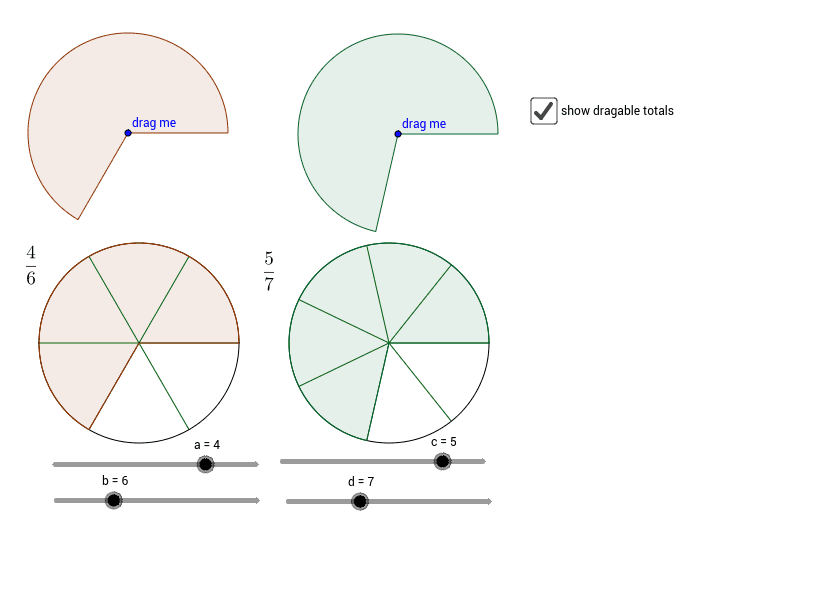
① This applet dynamically demonstrates the comparison of two proper fractions using fraction circles, allowing users to adjust numerators and denominators to observe changes in the shaded sectors. ② Core mathematical concepts include the meaning of fractions, proper fractions, comparing fractions, and the relationship between circle division and sector area proportion. ③ Construction highlights: using GeoGebra commands such as Circle, Point, Sequence, Sector, Vector, and Translate, it builds two concentric circles (cir1, cir2), generates equally spaced points via sequences, represents fractional parts as sectors, and uses vector translation and text objects (text1, text2) to display fraction values, along with auxiliary points (A, B, C, D, etc.) and lists (list1, list2) for dynamic updates. ④ Suitable for upper elementary to middle school students learning fraction concepts and comparison, and also useful for teacher demonstrations or student self-exploration to build an intuitive link between fractions and geometric area.
GeoGebra Commands & Parameters
Circle((0, 0), 2) → cir1Circle((5, 0), 2) → cir2Point({0, 0}) → APoint({5, 0}) → BSequence(Segment[A, ((2 * cos(((i * 2) * π / b))), (2 * sin(((i * 2) * π / b))))], i, 0, b - 1) → list1Sequence(Segment[B, (5 + (2 * cos(((i * 2) * π / d))), (2 * sin(((i * 2) * π / d))))], i, 0, d - 1) → list2Point({2, 0}) → CPoint({7, 0}) → DPoint({(2 * cos(((2 * π) * a / b))), (2 * sin(((2 * π) * a / b)))}) → ESector(cir1, C, E) → ePoint({5 + (2 * cos(((2 * π) * c / d))), (2 * sin(((2 * π) * c / d)))}) → FSector(cir2, D, F) → fVector(A, G) → uVector(B, H) → vTranslate(C, u) → C'Translate(E, u) → E'Sector(Translate[cir1, u], C', E') → e'Translate(D, v) → D'Translate(F, v) → F'Sector(Translate[cir2, v], D', F') → f'