
Fraction Addition: Cake Distribution Problems
Loading the math board and drawing, please wait…
In collections
Erstes Rechnen mit Brüchen - Addieren
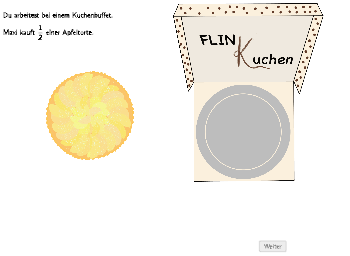
This GeoGebra example demonstrates fraction addition through the relatable context of cake distribution. The core mathematical concept is adding fractions with both like and unlike denominators, requiring students to sum fractions and simplify results. Construction highlights: Textfield inputs accept user fraction answers, LaTeX formats fraction expressions, Sequence and Circle commands create visual circle cake diagrams to intuitively show fraction sizes, while If conditions and Sum commands verify answer correctness. The example includes three open-ended problems: calculating total eighth-piece cakes Toni brought, finding addition expressions matching the diagram, determining how much more cake Maxi needs to reach one whole. Suitable for grades 5-6 students, can be used as in-class interactive practice or homework reinforcement.
GeoGebra Commands & Parameters
Sequence(Random[2, ANenner(5) - 3], i, 1, 100) → AZähler12, {4, 2, 9, 5, 5, 7, 4, 7, 8, 8, 8, 4, 2, 7, 2, 6, 9, 6, 6, 8, 4, 8, 7, 2, 5, 6, 3, 5, 5, 7, 3, 3, 8, 8, 4, 2, 4, 7, 4, 3, 3, 3, 9, 7, 7, 8, 7, 4, 2, 6, 5, 6, 5, 5, 5, 7, 2, 2, 9, 8, 9, 3, 5, 4, 7, 4, 7, 2, 2, 3, 8, 8, 9, 6, 8, 2, 9, 5, 3, 2, 4, 9, 6, 5, 5, 6, 5, 7, 3, 4, 7, 9, 5, 6, 3, 2, 7, 5, 9, 8}Sequence(Random[1, ANenner(4) - 2], i, 1, 100) → AZähler8, {6, 5, 6, 2, 5, 1, 4, 4, 3, 2, 6, 1, 1, 1, 3, 6, 6, 1, 3, 5, 1, 5, 4, 3, 5, 6, 2, 6, 1, 1, 3, 4, 6, 6, 4, 2, 6, 6, 5, 3, 3, 1, 6, 2, 1, 5, 3, 3, 6, 4, 6, 3, 2, 1, 4, 2, 6, 2, 1, 2, 6, 2, 6, 5, 1, 2, 4, 2, 4, 3, 3, 4, 4, 1, 3, 4, 6, 1, 2, 6, 6, 5, 5, 2, 3, 2, 6, 1, 5, 5, 4, 2, 4, 1, 1, 6, 2, 2, 2, 6}Sequence(Random[1, ANenner(3) - 2], i, 1, 100) → AZähler6, {3, 2, 2, 4, 1, 2, 1, 2, 3, 2, 2, 4, 3, 2, 2, 4, 2, 1, 1, 4, 4, 1, 1, 1, 2, 1, 4, 3, 3, 4, 4, 4, 3, 1, 1, 2, 1, 2, 4, 1, 4, 3, 3, 3, 1, 4, 4, 3, 4, 1, 1, 1, 2, 1, 4, 1, 1, 1, 3, 3, 4, 4, 1, 1, 2, 3, 3, 3, 2, 1, 1, 2, 2, 2, 1, 2, 4, 4, 1, 1, 3, 3, 2, 4, 1, 4, 2, 2, 3, 1, 1, 3, 3, 4, 2, 3, 3, 4, 2, 3}Join({{1}, Sequence[Random[1, ANenner(2) - 2], i, 1, 100]}) → AZähler4Sequence(Random[1, ANenner(1) - 1], i, 1, 100) → AZähler2, {1, 1, 1, 1, 1, 1, 1, 1, 1, 1, 1, 1, 1, 1, 1, 1, 1, 1, 1, 1, 1, 1, 1, 1, 1, 1, 1, 1, 1, 1, 1, 1, 1, 1, 1, 1, 1, 1, 1, 1, 1, 1, 1, 1, 1, 1, 1, 1, 1, 1, 1, 1, 1, 1, 1, 1, 1, 1, 1, 1, 1, 1, 1, 1, 1, 1, 1, 1, 1, 1, 1, 1, 1, 1, 1, 1, 1, 1, 1, 1, 1, 1, 1, 1, 1, 1, 1, 1, 1, 1, 1, 1, 1, 1, 1, 1, 1, 1, 1, 1}Join({{2, 1, 3, 4, 5}, Sequence[Random[1, 5], i, 1, 100]}) → CaseAnzahlListIf(questionCount ≟ 1, 1, Nenner - abs(Random[AnzahlA + If[Case ≠ 1, 1, 0], Nenner - 1])) → AnzahlBCentroid(LApfelZwoeftel12(1)) → MidPoint_{LApfelZwoeftel12}Centroid(LApfelZwoeftel11(1)) → MidPoint_{LApfelZwoeftel11}Centroid(LApfelZwoeftel10(1)) → MidPoint_{LApfelZwoeftel10}Centroid(LApfelZwoeftel9(1)) → MidPoint_{LApfelZwoeftel9}Centroid(LApfelZwoeftel8(1)) → MidPoint_{LApfelZwoeftel8}Centroid(LApfelZwoeftel7(1)) → MidPoint_{LApfelZwoeftel7}Centroid(LApfelZwoeftel6(1)) → MidPoint_{LApfelZwoeftel6}Centroid(LApfelZwoeftel5(1)) → MidPoint_{LApfelZwoeftel5}Centroid(LApfelZwoeftel4(1)) → MidPoint_{LApfelZwoeftel4}Centroid(LApfelZwoeftel3(1)) → MidPoint_{LApfelZwoeftel3}Centroid(LApfelZwoeftel2(1)) → MidPoint_{LApfelZwoeftel2}Centroid(LApfelZwoeftel1(1)) → MidPoint_{LApfelZwoeftel1}Centroid(LApfelSechstel6(1)) → MidPoint_{LApfelSechstel6}Centroid(LApfelSechstel5(1)) → MidPoint_{LApfelSechstel5}Centroid(LApfelSechstel4(1)) → MidPoint_{LApfelSechstel4}Centroid(LApfelSechstel3(1)) → MidPoint_{LApfelSechstel3}Centroid(LApfelSechstel2(1)) → MidPoint_{LApfelSechstel2}Centroid(LApfelSechstel1(1)) → MidPoint_{LApfelSechstel1}Centroid(LApfelViertel2(1)) → MidPoint_{LApfelViertel2}Centroid(LApfelViertel3(1)) → MidPoint_{LApfelViertel3}Centroid(LApfelViertel4(1)) → MidPoint_{LApfelViertel4}Centroid(LApfelViertel1(1)) → MidPoint_{LApfelViertel1}Centroid(LApfelHalb2(1)) → MidPoint_{LApfelHalb2}Centroid(LApfelHalb1(1)) → MidPoint_{LApfelHalb1}Circle(PointTeller00, width) → TellerCentroid(LApfelAchtel7(1)) → MidPoint_{LApfelAchtel7}Centroid(LApfelAchtel6(1)) → MidPoint_{LApfelAchtel6}Centroid(LApfelAchtel5(1)) → MidPoint_{LApfelAchtel5}Centroid(LApfelAchtel4(1)) → MidPoint_{LApfelAchtel4}Centroid(LApfelAchtel3(1)) → MidPoint_{LApfelAchtel3}Centroid(LApfelAchtel2(1)) → MidPoint_{LApfelAchtel2}Centroid(LApfelAchtel1(1)) → MidPoint_{LApfelAchtel1}Centroid(LApfelAchtel8(1)) → MidPoint_{LApfelAchtel8}Sum({Anzahl2Halbe, Anzahl4Viertel, Anzahl6Sechstel, Anzahl8Achtel, Anzahl12Zwoelftel}) → AnzahlIf(page ≟ 1, Anzahl, If[Anzahl ≥ AnzahlA, AnzahlA, Anzahl]) → CounterAIf(Anzahl - AnzahlA ≤ 0, 0, Anzahl - AnzahlA) → CounterBShuffle(Split["Hawa, Flo, Pauli, Kim, Michi, Maxi, Zamir, Tami, Lisi", {", "}]) → ANamen, {"Maxi", "Kim", "Zamir", "Tami", "Pauli", "Michi", "Lisi", "Hawa", "Flo"}Split("Halb, Viertel, Sechstel, Achtel, Zwölftel", {", "}) → ABezeichnungJoin({{3}, Sequence[Random[1, 2], i, 1, 100]}) → CaseSorteIf(page ≟ 1, AnzahlA ≟ CounterA, page ≟ 1.5, AnzahlB ≟ CounterB, page ≟ 2, correct2, true) → fixedTextfield(aInput) → Eingabefeld1LaTeX(page, true, true) → Text2Textfield(cInput) → Eingabefeld2
AI Drawing Prompt Reference
Draw a cake distribution problem diagram with 8 differently sized cake slices, including 1/2, 1/4, 1/6, 1/8, and 1/12, and 1 whole cake. Use text input boxes for users to enter answers, display fraction addition expressions, and validate answers with circles and conditional statements.
The prompt above was compiled from the original drawing commands and is for reference only.